How to prepare for your first online guitar lesson
Prepare for your first online guitar lesson with a playable instrument, clear camera setup, realistic goals and a simple plan for practising afterwards.
August 20265 min read
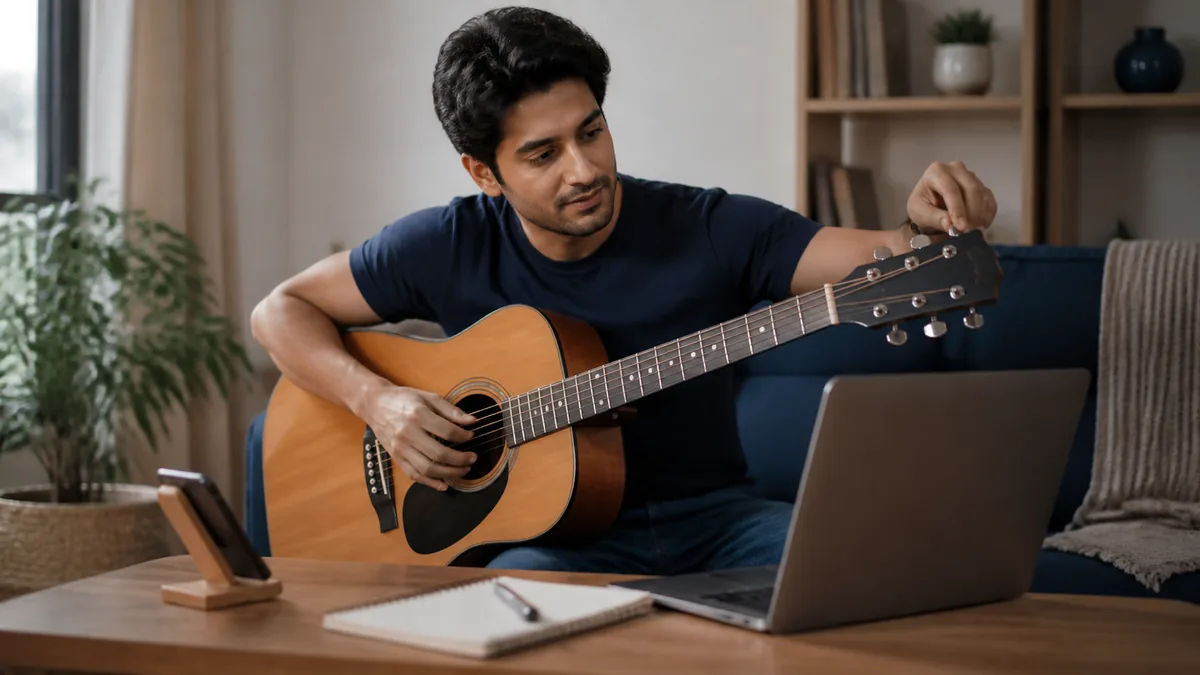
Your first online guitar lesson does not require a perfect instrument, expensive recording equipment or prior musical knowledge. It does require enough preparation for the teacher to see your hands, hear the guitar and understand what you want to learn.
Knowing how to prepare for your first online guitar lesson also reduces the time spent solving avoidable technical problems. A few checks before class leave more room for playing, feedback and a useful next step.
Decide what you want from the lesson
You do not need a complete long-term plan. Give the teacher a simple starting point: whether you are completely new, returning after a break or trying to solve a specific problem.
- I have never played guitar and want to learn the basics.
- I know a few chords but cannot change between them smoothly.
- I want to play and sing songs.
- I am interested in riffs, lead guitar or fingerstyle.
- I learned before and want a structured restart.
- I want feedback on posture, rhythm or another technique issue.
Bring one or two song examples if they explain your taste. The first lesson may not teach the entire song, but the examples help the teacher connect foundational work to music you enjoy.
Check that the guitar is playable
Take the guitar out before the call. Look for missing strings, obviously loose parts or severe tuning problems. If the strings feel unusually difficult to press or the guitar produces heavy buzzing across many notes, mention it to the teacher rather than assuming you lack finger strength.
- Confirm that all six strings are present.
- Turn each tuning machine gently and check that it responds.
- Wipe visible dust from the strings and neck.
- Sit with the guitar and check whether its size feels manageable.
- Keep a tuner or tuning app ready.
- If you already use a pick, place it beside the guitar.
Do not make major adjustments to the bridge, neck or string height immediately before class unless you know how the instrument is set up. A teacher can first help identify whether professional hands-on inspection may be useful.
Compare acoustic and electric guitar for beginners
Use the device you already understand
A phone, tablet or computer can work for an introductory lesson when its camera and microphone function reliably. The best device is usually the one you can place securely and operate without interrupting the class.
Charge it, install or update the agreed video-call app and sign in before the lesson. Open the meeting link once in advance if possible so you know which permissions the app requests.
Position the camera for teaching
A close view of your face is useful for conversation but does not show enough of the instrument. Move the device back until the teacher can see the guitar neck, fretting hand, picking or strumming hand and your upper-body posture.
- Place the device on a stable stand or firm surface.
- Use landscape orientation if it shows both hands more clearly.
- Keep the headstock and strumming hand inside the frame.
- Angle the fretting fingers toward the camera when possible.
- Avoid placing a bright window directly behind you.
- Sit in the same position you will use during the lesson.
Check your own video preview. If the hands appear too small, move closer; if one hand disappears whenever you play, widen the view.
Use the complete equipment checklist for online guitar classes
Test what the teacher will hear
Play the guitar at your normal volume while recording a short test clip. Listen for strong fan noise, television, nearby conversation or a microphone covered by a case or clothing.
For an electric guitar, choose a simple clean or lightly driven sound at a comfortable room volume for the initial check. Complex effects can make it harder to hear timing and note clarity. Keep the amplifier where the device can hear it without overwhelming speech.
Explore Jam And Play's electric guitar classes
Prepare a quiet and comfortable space
Choose a chair or stool that lets you hold the guitar without fighting the armrests. Keep enough space around the neck so it does not hit a wall or furniture when you adjust your position.
- Tell people nearby when the lesson will happen.
- Silence nonessential phone and computer notifications.
- Keep water within reach but away from electronics.
- Place the charger where it will not pull the device over.
- Keep a notebook or notes app ready.
- Remove other instruments or objects that restrict the camera view.
Join a few minutes early
Joining early gives you time to solve microphone, camera or link problems without using the lesson itself. It also lets you tune and settle into a natural playing position.
If the teacher has provided a specific platform or meeting instruction, follow that rather than opening several apps at once. Keep the teacher's contact method available in case the link fails.
What to tell the teacher at the beginning
- Whether you are a complete beginner or have played before.
- Which guitar and basic equipment you are using.
- What music you enjoy and what you hope to play.
- How much time you can realistically practise.
- Any chord, rhythm or technique problem you already notice.
- Any discomfort that affects how you hold or play the instrument.
Be accurate about your experience. There is no advantage in hiding what you do not know or trying to perform above your current level. A useful first lesson begins from what you can do today.
What may happen in the first lesson
The exact lesson will depend on your level and goals. A complete beginner may work on holding the guitar, tuning, identifying strings, producing a clear note or learning a simple rhythm. A returning player may be asked to play familiar material so the teacher can assess timing and technique.
- A short conversation about goals and musical interests.
- A check of the guitar, sitting position and camera angle.
- Tuning or learning how tuning works.
- A small playing task to assess coordination and rhythm.
- One or two corrections that can be tested immediately.
- A clear practice assignment for the next lesson.
A first lesson does not need to cover everything. Its value comes from identifying the right starting point and giving you a task you understand well enough to repeat independently.
Ask questions while the movement is visible
If an instruction is unclear, ask the teacher to demonstrate it again or describe what you should feel and hear. Move the camera closer when the question concerns a particular hand.
- Which part of my finger should contact the string?
- How much pressure is actually necessary?
- What should a correct repetition sound like?
- How slowly should I practise this?
- What should I do if one string remains muted?
- Which mistake should I correct first?
Learn how online guitar lessons can correct technique
Write down the practice task before leaving
Do not rely on remembering a full conversation. Before the call ends, confirm the small set of tasks you should practise, the order in which to do them and how to recognise a correct attempt.
- The exercise, chord change, rhythm or song section.
- A comfortable starting tempo if one is being used.
- The number of short practice sessions to aim for.
- The main technique point to monitor.
- What to record or prepare for the next class.
- What to do if the assignment causes confusion or unusual discomfort.
Use a simple first-week routine
The goal after lesson one is to remember and repeat the new movement accurately. Short sessions make it easier to notice when attention or hand comfort starts to decline.
- Tune the guitar.
- Review the teacher's main correction.
- Practise the smallest exercise slowly.
- Apply it to the assigned chord, riff or song section.
- End with one controlled attempt rather than playing until exhausted.
- Note one question for the next lesson.
If sharp pain, numbness or unusual discomfort appears, stop forcing the movement. A guitar teacher can help with playing technique, but persistent symptoms may need appropriate professional assessment.
See a realistic guide to lesson frequency for beginners
Avoid these first-lesson distractions
- Buying unnecessary equipment before testing your current setup.
- Trying to tune for the first time after the call begins.
- Holding the phone in one hand during the lesson.
- Preparing a difficult performance to impress the teacher.
- Starting multiple unrelated tutorials before the next class.
- Leaving without a clear practice task.
Use the first lesson to test the class as well
A demo or introductory lesson helps you assess the teaching process, not only your own ability. Notice whether the teacher listens to your goals, watches you play and gives specific feedback.
- Could the teacher see and hear the guitar clearly?
- Did you spend meaningful time playing?
- Was the correction understandable and testable?
- Did the material match your current level?
- Do you know what to practise next?
- Does the schedule and format fit your routine?
Compare one-to-one and group online guitar classes
Arrive ready to learn, not ready to perform
To prepare for your first online guitar lesson, check the instrument, camera, audio and meeting link, then bring an honest description of your level and goals. The lesson should help establish a practical starting point rather than test whether you already deserve to learn.
Jam And Play offers live online guitar lessons with personalised guidance. Book a free demo to test your setup, discuss your musical goals and leave with a clear first practice plan.
Want a clearer first step?
Meet a mentor, talk about what you want to play and get a learning plan built around your schedule.