How often should beginners take online guitar lessons?
Learn how often beginners should take online guitar lessons based on practice time, goals, feedback needs, schedule and lesson format.
August 20265 min read
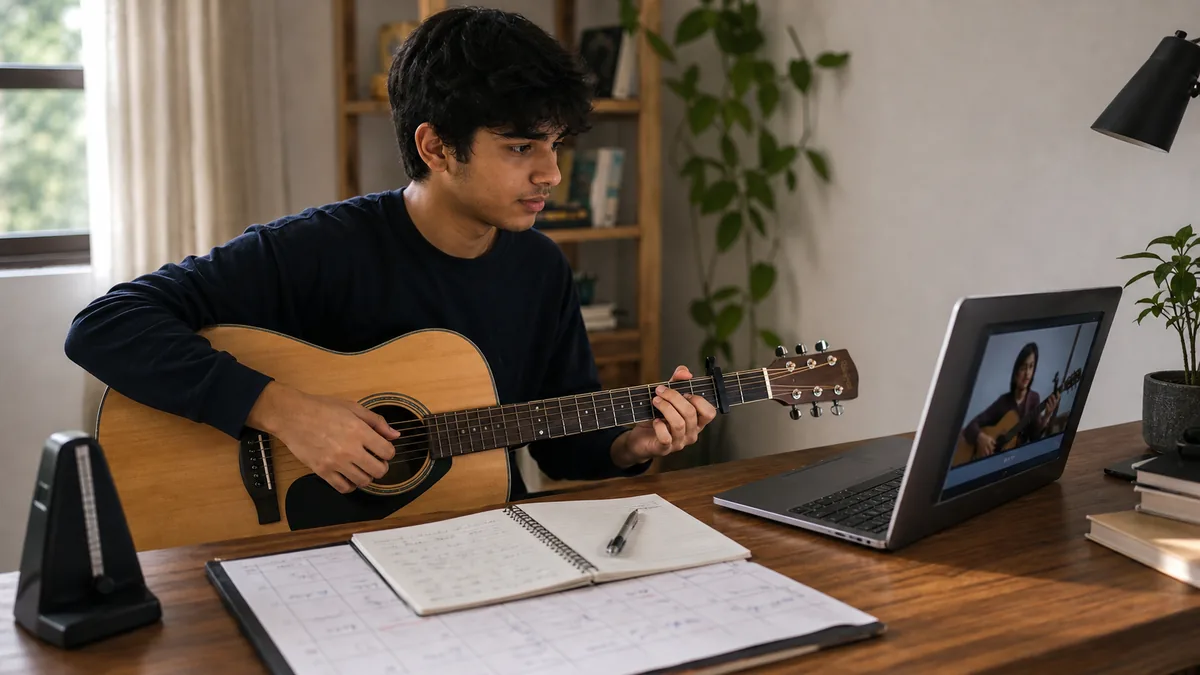
Most beginners do not need the maximum number of lessons they can fit into a week. They need enough live guidance to correct mistakes, plus enough time between classes to practise what they learned. That balance is different for a complete beginner, a busy adult and someone preparing for a specific musical goal.
So, how often should beginners take online guitar lessons? For many learners, one well-structured lesson each week is a practical starting point. Some benefit from two shorter lessons, while others need a lesson every two weeks because their schedule allows slower progress. The right frequency is the one that creates a repeatable cycle of learning, practice, feedback and adjustment.
Start with one lesson per week
A weekly online guitar lesson gives a beginner a clear assignment and several days to work on it. The teacher can check posture, chord clarity, rhythm and practice habits before small problems settle into automatic movements.
This schedule often works well when the student can practise in short sessions on several days between lessons. The class introduces or corrects a skill; the days afterward are for repetition. At the next class, the teacher reviews the result and decides whether to move forward or simplify the task.
See how Jam And Play's live online guitar classes work
When two lessons per week can help
Two lessons a week may suit a beginner who needs closer feedback, has a near-term performance goal or struggles to practise independently. Shorter gaps can prevent confusion from lasting an entire week.
- A young learner benefits from shorter, more frequent contact.
- The student is preparing several skills at the same time, such as chords, rhythm and a song.
- A specific technique keeps causing discomfort or unclear notes.
- The learner practises regularly and is ready for the next step before the week ends.
- The second meeting has a clear purpose rather than simply repeating the first lesson.
More classes do not automatically mean faster improvement. If both lessons are filled with new material and there is no practice time between them, the student may collect exercises without developing control.
When a lesson every two weeks may be realistic
A fortnightly lesson can work for a self-directed learner who already understands basic practice methods and needs periodic correction. It can also be a temporary choice during a demanding work or study period.
The risk is that a small misunderstanding may be repeated for many days. A two-week plan should therefore be specific: what to practise, how slowly to play it, what a correct repetition should sound or feel like and what to record for review.
Complete beginners who are unsure about tuning, hand position or rhythm may find such a long gap difficult at first. Beginning weekly and reducing the frequency later is often easier than trying to solve several weeks of confusion in one class.
Use practice time to choose the frequency
Lesson frequency should match the time available between lessons. A student with four short practice opportunities may be ready for a weekly class. Someone who can practise only once may need to protect a smaller routine before adding another lesson.
- If you practise briefly on most days, a weekly lesson can keep the plan moving.
- If your week is unpredictable, schedule one main lesson and use a simple fallback practice session.
- If you consistently finish the assignment early, discuss a second class or a more detailed weekly plan.
- If every lesson begins with unfinished work, reduce the assignment before changing the class frequency.
- If pain or unusual discomfort appears, stop forcing repetitions and ask for technique guidance.
Use this 20-minute guitar practice routine for busy adults
Lesson length and lesson frequency are connected
One long class is not always better than two focused sessions. Attention, age, level and the type of material matter. A young beginner may learn more from a compact lesson with one clear goal, while an adult may prefer enough time to review technique, rhythm and a song in the same meeting.
Ask what the lesson is expected to cover. If a class repeatedly ends before the teacher can hear the student play, the issue may be structure rather than frequency. If attention fades before the end, a shorter format may be more useful.
One-to-one and group classes may need different rhythms
In a one-to-one class, the lesson can follow one student's pace. A teacher may spend the full session on a difficult chord change or move quickly when a concept is secure. In a group, the schedule also has to support shared activities and the pace of other learners.
Neither format determines the perfect number of weekly lessons. What matters is how much individual playing time, correction and follow-up the student receives.
Compare one-to-one and group online guitar classes
Match the schedule to your goal
A beginner learning a few songs for personal enjoyment may not need the same frequency as a learner preparing for an audition, exam or performance. Define the next small result before deciding how many classes to book.
- For a new hobby: build a comfortable weekly practice habit and learn foundational chords and rhythm.
- For playing and singing: focus on steady chord changes, strumming and manageable song sections.
- For technique repair: use closer feedback until the movement is understood, then leave time for repetition.
- For a dated goal: work backward from the date and include full run-throughs, not only lesson time.
- For returning after a break: assess what is still comfortable before choosing an intensive schedule.
Read a realistic beginner timeline for learning guitar
Signs your current frequency is working
A useful schedule produces small, observable changes between lessons. You do not need to complete a song every week. Cleaner notes, steadier timing and fewer pauses are meaningful signs that the lesson-practice cycle is working.
- You understand what to practise after each class.
- The assignment is challenging but possible within your week.
- You can show at least one improvement at the next lesson.
- Corrections become easier to remember and apply.
- You still have enough energy to play music you enjoy.
Signs you should adjust the schedule
Change the plan when the current rhythm creates repeated overload or long periods without direction. The solution could be a different frequency, but it could also be a smaller assignment, a shorter lesson or a more consistent practice slot.
- New material arrives faster than you can practise it.
- You spend several days unsure whether an exercise is correct.
- Work, school or family commitments cause frequent missed classes.
- Every lesson repeats the same correction without a clear practice method.
- You practise regularly but receive too little feedback to know what to change.
Questions to ask before choosing a plan
- How many days can I realistically practise between lessons?
- Do I need help with fundamentals or feedback on material I can already study?
- Will the teacher provide a clear practice plan after class?
- Can the lesson time remain consistent during busy weeks?
- How will we review whether the frequency is still suitable?
- Does the format give me enough time to play and receive correction?
A simple four-week test
If you are uncertain, begin with one lesson each week for four weeks and treat it as a test. Keep a short note after every practice session: what you worked on, what improved and what remained confusing. Bring those notes to class.
At the end of the four weeks, review the pattern with the teacher. If you are completing the plan comfortably and need faster feedback, consider adding contact. If work is constantly unfinished, simplify the plan before assuming you need more lessons.
Choose consistency over intensity
For most beginners, a dependable weekly online guitar lesson is a sensible place to start. Two lessons can help when the student has the practice time and a clear reason for closer guidance. Fortnightly lessons may suit more independent learners, provided the practice plan is detailed enough to prevent drift.
Jam And Play offers live online guitar lessons with personalised guidance and flexible scheduling. Book a free demo to discuss your current level, available practice time and a lesson rhythm you can maintain.
Want a clearer first step?
Meet a mentor, talk about what you want to play and get a learning plan built around your schedule.