Online guitar classes for NRI students: what to check before you join
Choosing online guitar classes for NRI students is easier when you compare live feedback, time-zone fit, lesson structure and the music you actually want to play.
August 20265 min read
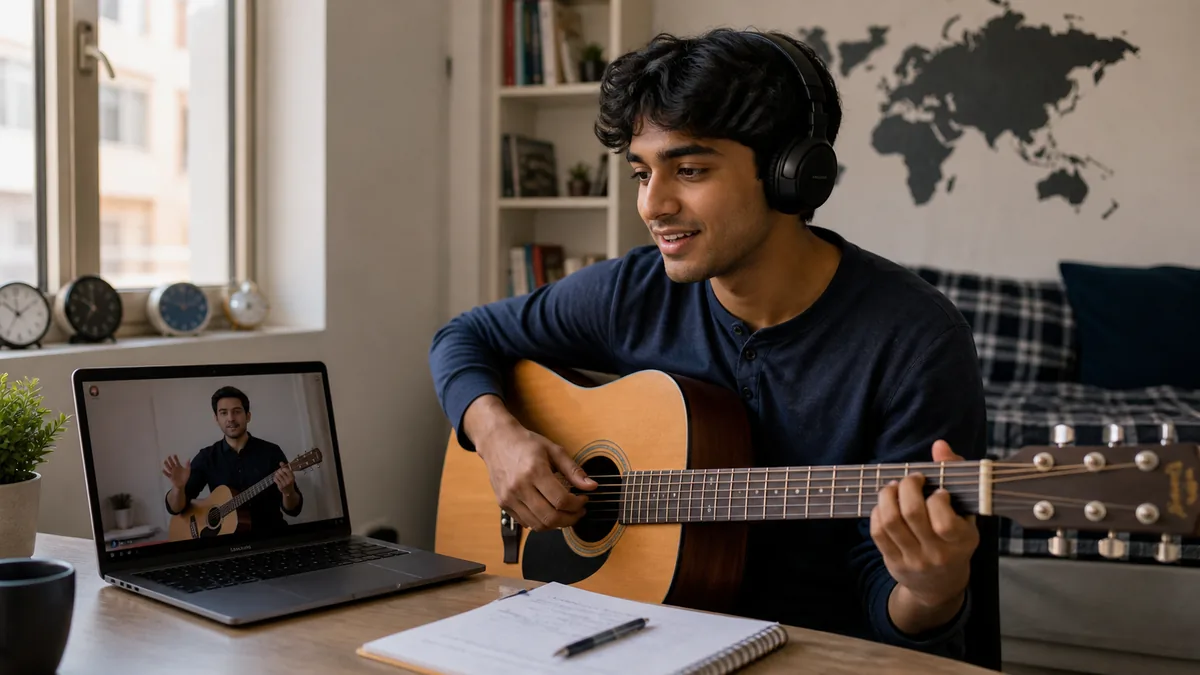
Learning guitar from another country sounds simple: open a laptop, meet a teacher and start playing. In practice, the quality of an online lesson depends on details that are easy to miss when you first compare classes. A convenient time slot matters, but so do live feedback, a clear learning sequence and a teacher who understands the music you want to play.
For NRI learners and families, the right class should feel personal even when the teacher is thousands of kilometres away. This guide explains what to check before you enrol, whether the student is an adult returning to music or a beginner learning for the first time.
What makes online guitar classes for NRI students different?
The instrument is the same everywhere, but the learning routine may not be. School, work and family schedules follow a different time zone from the teacher. Students may want a mix of Bollywood songs, Indian independent music and international pop or rock. Parents may also want clear updates without turning every practice session into a negotiation.
A useful online program accounts for those realities. It does not simply move an offline class onto a video call. The teacher needs a plan for camera setup, audio clarity, lesson notes, practice tasks and progress between sessions.
Start with the time zone, not only the advertised timing
A class time can look suitable on paper and still be difficult to maintain. Before choosing a slot, think about the learner's energy as well as availability. A child may technically be free late in the evening but too tired to concentrate. A working professional may need a small buffer after work instead of joining immediately after the last meeting.
- Convert the lesson time for both locations and confirm whether daylight-saving changes will affect it.
- Choose a slot that can remain consistent on most weeks.
- Ask how rescheduling works when school, travel or work interrupts the routine.
- Leave enough time before the lesson to tune the guitar and set up the camera.
Jam And Play has country-specific pages for learners in several regions, so you can check the relevant scheduling information before booking a conversation.
Explore online music lessons for students in the United States
Explore online music lessons for students in the United Kingdom
Explore online music lessons for students in the UAE
Read the checklist for choosing online guitar classes for NRI teenagers
Choose live feedback over a video library when you need guidance
Recorded lessons are useful for revision, but they cannot hear a buzzing chord, notice a tense wrist or tell you that your strumming is drifting ahead of the beat. Those small corrections are especially important at the beginning because repeated mistakes can quickly become habits.
In a live lesson, the teacher can ask you to move the camera, play the same section slowly and make one specific correction at a time. That interaction is what turns an online video call into an actual class.
See how Jam And Play's live online guitar classes work
Ask for a roadmap that matches the learner
A good roadmap gives direction without treating every learner as identical. A complete beginner may start with posture, tuning, simple tabs, rhythm and a few open chords. Someone who already knows basic chords may need help with clean transitions, strumming, timing or playing complete songs.
Before joining, ask what the first four to six lessons are likely to cover and how that plan will change if the student progresses faster or needs more time. The answer should be clear enough to understand without promising an identical result for every learner.
Make sure the musical goals feel relevant
Students practise more willingly when the music feels connected to their taste. An NRI learner may want to play Hindi film songs with family, learn popular English songs, prepare graded pieces or build the skills to explore music independently. Those goals can share the same technical foundation, but they should not lead to exactly the same lesson.
- Share two or three songs the learner genuinely enjoys.
- Explain whether the goal is casual playing, singing with guitar, performance or an exam.
- Ask how technique and theory will be connected to real music.
- Check whether the teacher can adjust song choices while keeping the learning sequence intact.
Prepare a simple online lesson setup
You do not need a complicated studio. A stable internet connection, a charged device and a quiet corner are enough to begin. Place the camera so the teacher can see both hands and the guitar neck. Headphones can sometimes make conversation clearer, but the teacher also needs to hear the instrument naturally, so test the setup during the demo lesson.
Keep a tuner, picks, notebook and any lesson material within reach. Spending two minutes preparing before class protects the time that should be used for playing.
What should happen between lessons?
Progress is built between classes, but the practice plan has to be realistic. A vague instruction such as “practise more” is not very helpful. A better task identifies what to practise, how slowly to begin and what a successful attempt should sound or feel like.
For a busy learner, a short routine might include a warm-up, one chord-change exercise, a rhythm exercise and a small section of a song. The exact duration matters less than having a repeatable plan that fits normal weekdays.
Use the demo lesson as a real test
A demo is not only a chance to meet the teacher. Use it to test the video and sound, discuss the learner's goals and see whether the feedback is specific. The learner should leave knowing one useful thing to practise next.
- Did the teacher listen before suggesting a plan?
- Was the correction clear and practical?
- Could both hands be seen and the guitar be heard properly?
- Did the proposed schedule feel sustainable?
- Was there a clear next step after the lesson?
A practical first step for NRI learners
The best online guitar class is not necessarily the one with the biggest course library or the boldest promise. It is the one that fits the learner's time zone, gives useful live feedback and makes the next practice session clear.
Jam And Play offers live online guitar lessons with flexible scheduling and a roadmap shaped around the learner's current level and musical interests. Start with a free one-to-one demo, test the setup and discuss what you would genuinely like to play before deciding on the next step.
Want a clearer first step?
Meet a mentor, talk about what you want to play and get a learning plan built around your schedule.