What is the best age for a child to start guitar lessons?
There is no single perfect age to start guitar. Many children are ready for formal lessons around six to eight, but age alone does not decide it. Hand size, attention, interest and the teacher's approach matter more.
August 20264 min read
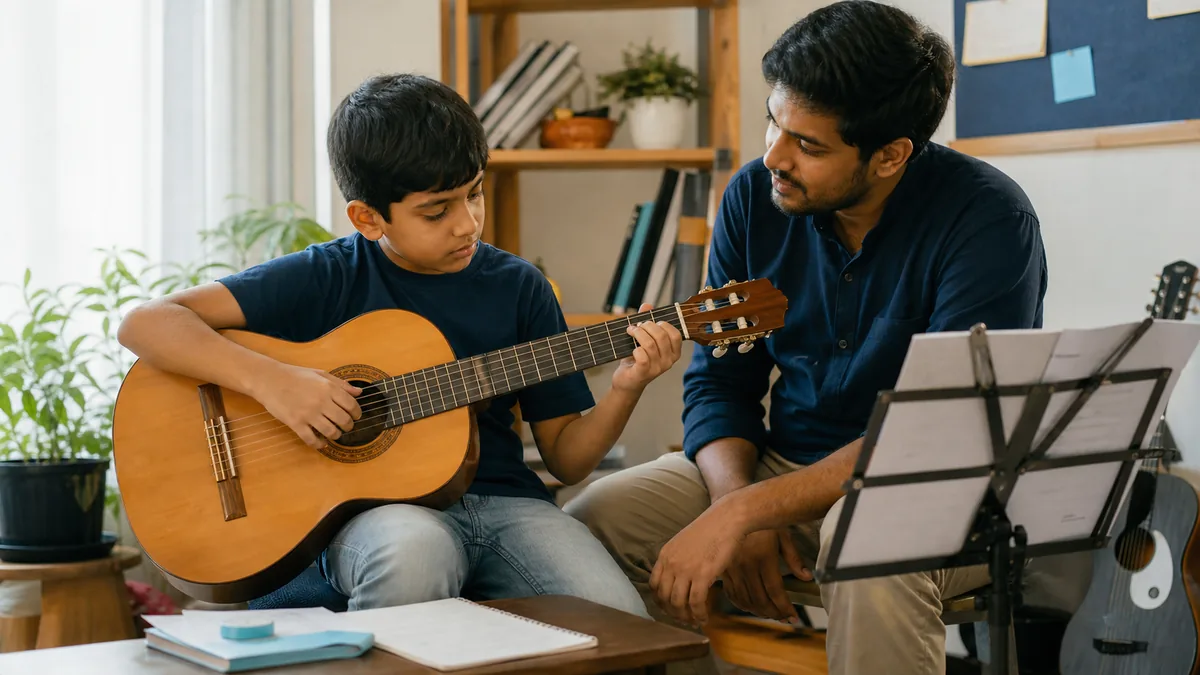
There is no single perfect age to start guitar. Many children are ready for formal lessons around six to eight, but age alone does not decide it. Hand size, attention, interest and the teacher's approach matter more.
A child who asks to play and can follow short instructions may be ready earlier. Another child may enjoy music but prefer keyboard, ukulele or rhythm games before moving to guitar.
Signs your child may be ready
- They show interest in songs, instruments or copying simple rhythms.
- They can focus on one activity for fifteen to twenty minutes.
- They can follow two-step instructions without becoming frustrated.
- They are willing to practise briefly between lessons.
- They can hold a suitable instrument without strain.
The instrument must fit
A full-size guitar can feel enormous to a young child. Smaller classical or acoustic guitars may be more comfortable, and nylon strings can feel gentler on new fingers. A ukulele is another friendly starting option because it is light, compact and uses simple chord shapes.
Ask a teacher to check size and posture before buying. An unsuitable instrument can look like a lack of ability when the real problem is reach.
What early lessons should look like
Young beginners need variety inside a clear routine. A lesson may combine rhythm clapping, one chord, a short melody and a familiar song. The teacher should use simple language and allow time for repetition.
Progress may be slower than an adult expects. That is not a problem. The early goal is to build coordination, listening and a positive relationship with practice.
How long should children practise?
Ten focused minutes can be enough for a young beginner. Older children may manage fifteen to twenty-five minutes. Stop before practice turns into a daily argument. Regular short sessions are more useful than a long forced session before class.
What parents should do
Create a regular time, keep the instrument easy to reach and praise specific effort. "Your rhythm stayed steady today" is more useful than "You are talented." Sit nearby when needed, but allow the child to solve small problems independently.
Parents do not need to understand guitar. A short weekly note from the teacher can make the practice plan clear.
Online lessons for children
Online classes can work when the child has a quiet space, a clear camera angle and an adult nearby for setup. The adult should help with the device, not answer every question or correct the child during the lesson.
When to wait
If the child has no interest, cannot hold the instrument comfortably or becomes upset after a few minutes, pause and try again later. Music should involve discipline, but it should not feel like a punishment.
A demo lesson helps the teacher assess readiness, guitar size and attention span before the family commits to a longer plan.
Book a child-friendly demo and get advice on the right instrument and lesson format. Book a free demo
Want a clearer first step?
Meet a mentor, talk about what you want to play and get a learning plan built around your schedule.