Can you learn guitar online without reading music?
Learn guitar online without reading standard music by using chords, tabs, rhythm and live feedback—plus when notation may become useful later.
August 20265 min read
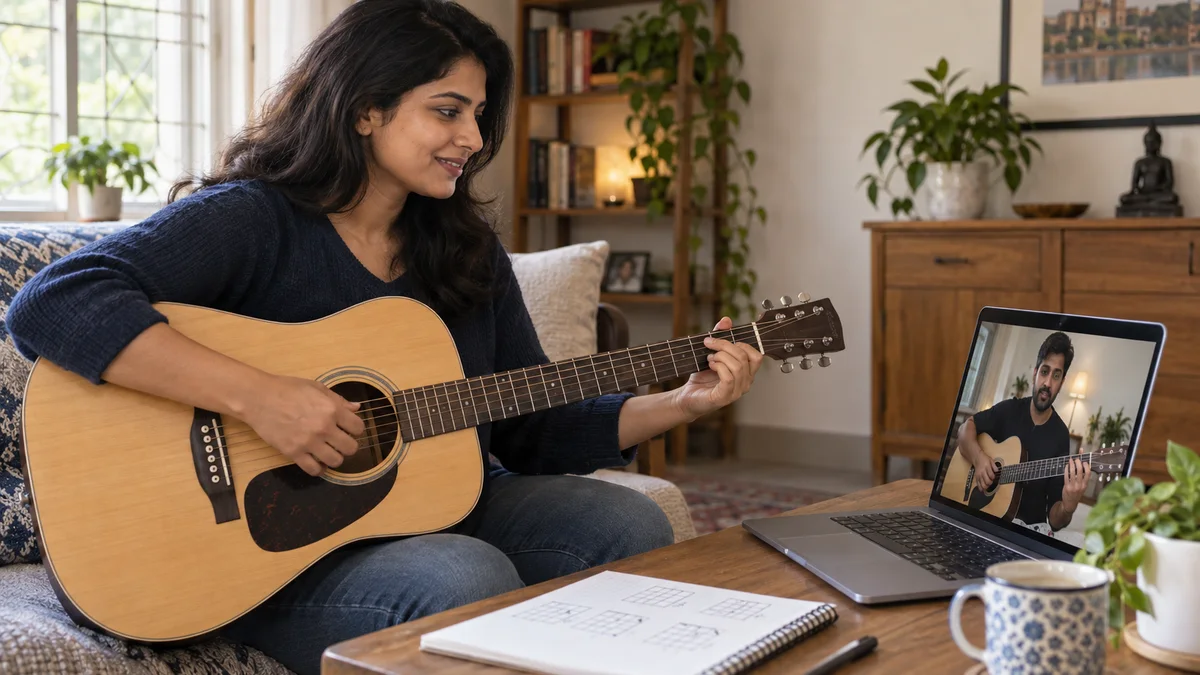
Many beginners delay guitar lessons because they believe they must first learn to read traditional sheet music. That is not usually necessary for playing your first chords, riffs, melodies or songs.
You can learn guitar online without reading standard music by using chord diagrams, tablature, rhythm counting, listening and live teacher feedback. Standard notation can still become valuable later, depending on your goals, but it does not have to be the entrance test.
What does reading music mean?
People often use the phrase reading music for several different skills. Separating them makes the learning path much clearer.
- Standard notation shows pitch, rhythm and other musical instructions on a staff.
- Guitar tablature shows which string and fret to play.
- Chord diagrams show where to place the fingers for a chord shape.
- Chord charts show the order and timing of chords in a song.
- Rhythm notation or written strumming patterns describe when the hand moves.
- Listening and demonstration help you copy sound, timing and technique.
A beginner may use several of these systems without reading a traditional score. The important question is whether the method gives enough information to play accurately and understand what to practise.
What can you learn without standard notation?
- How to hold and tune the guitar.
- Open chords and power chords.
- Chord changes and common progressions.
- Strumming patterns and steady counting.
- Riffs, melodies and basic lead parts through tablature.
- Finger exercises and simple scales.
- Songs taught through demonstrations, tabs and chord charts.
- Basic improvisation and fretboard patterns.
These skills still require careful listening and repetition. Avoiding standard notation does not mean avoiding rhythm, technique or musical understanding.
See how Jam And Play's live online guitar classes work
Chord diagrams are a practical starting point
A chord diagram represents the guitar neck vertically and marks the strings and frets used in one shape. It can show which fingers to place, which strings to play and which strings to avoid.
The diagram does not automatically teach finger pressure, wrist comfort or how to change between chords. A teacher can watch the movement and help turn the static picture into a clean, repeatable sound.
Guitar tablature explains where to play
Tablature uses six horizontal lines for the guitar strings and numbers for frets. It gives beginners a direct way to locate notes for riffs, melodies and exercises.
Basic tab may not communicate rhythm clearly unless rhythmic values, stems or other notation are added. Listen to the musical example, count the beat and ask how long each note should last rather than reading only the fret numbers.
Rhythm cannot be skipped
A correct chord played at the wrong time still disrupts the song. Beginners who avoid sheet music sometimes also avoid counting, but these are separate choices.
- Count steady beats aloud.
- Clap a rhythm before playing it.
- Use simple downstrokes while keeping the hand moving.
- Practise with a metronome or suitable backing pulse.
- Slow the song until chord changes fit inside the beat.
- Record a short section and listen for pauses or rushing.
Rhythm can be taught through counting, demonstration and simple written patterns before a student understands staff notation.
Listening is part of reading the song
Tabs and chord charts describe part of the music. Listening reveals feel, accents, tone, dynamics and the relationship between sections.
Use a short loop of the assigned section. Listen once for the beat, once for the guitar rhythm and once for where the chord or phrase changes. Then return to the instrument with one specific detail to copy.
Why live online feedback still matters
A video or diagram cannot see that a finger is muting the next string, that the pick is turning in the hand or that the rhythm stops during every chord change. Live feedback can identify the physical cause instead of giving you another diagram.
During an online lesson, the teacher can demonstrate a small part, watch you repeat it and adjust the camera angle when the movement is unclear.
Learn how online lessons can correct guitar technique
A beginner learning path without standard notation
The exact order should match the instrument and musical goal, but a structured path may look like this.
Stage 1: sound and coordination
- Learn sitting or standing posture.
- Tune with guidance.
- Produce clear single notes.
- Understand string names and fret numbers.
- Keep a simple steady pulse.
Stage 2: chords and rhythm
- Read a few chord diagrams.
- Check each string for clarity.
- Change between two shapes slowly.
- Count four beats and use a simple strumming motion.
- Apply the changes to a short song section.
Stage 3: tabs and melodies
- Read one string and fret at a time.
- Follow a short finger exercise or melody.
- Add the correct picking direction when required.
- Match the notes to a steady pulse.
- Connect small phrases instead of restarting the full piece.
Stage 4: musical understanding
- Learn the names of notes used in familiar shapes.
- Understand how beats form bars.
- Recognise repeated chord progressions.
- Connect a scale pattern to a key or chord.
- Begin reading rhythm or notation when it serves the goal.
This approach does not reject theory. It introduces musical ideas through sounds and movements that the student can already recognise.
When standard notation becomes useful
Standard notation may become more important when you want to sight-read, study classical guitar, work from scored ensemble music, communicate exact rhythms or prepare material that specifically requires notation.
It can also strengthen fretboard knowledge because the same written pitch may be available in more than one place on the guitar. The teacher can introduce notation gradually instead of pausing all practical playing until it is mastered.
Do graded exams require music reading?
Exam pathways differ by syllabus, instrument and format. Do not assume every guitar exam tests the same reading skills. Check the current official syllabus for the exact pathway you are considering and ask a teacher to assess the requirements.
Read the beginner guide to Trinity guitar exams
Tabs have limits
- Some tabs do not show rhythm accurately.
- Online tabs may contain incorrect notes or positions.
- Fret numbers do not explain how to produce a clean sound.
- Tabs may not show fingering, muting or picking clearly.
- Following numbers alone can hide the key, chord and song structure.
Use tabs as one source of information, then confirm the sound, timing and technique through listening and feedback.
Avoid becoming dependent on visual instructions
A learner can become so focused on the screen that they stop listening. After understanding a short section, look away from the tab and play from memory. This reveals whether you know the music or are only following numbers.
- Read one short phrase.
- Play it slowly while looking at the instruction.
- Repeat it without looking.
- Listen for pitch and rhythm.
- Return to the tab only to correct a specific detail.
Choose songs at the right difficulty
A song may have a simple chord chart but a difficult recorded arrangement. A teacher can simplify the rhythm, reduce the number of chords or teach one recognisable riff while the underlying skills develop.
The simplified version should still have a purpose. It may train chord changes, timing, picking or finger independence before the complete arrangement becomes realistic.
See a realistic beginner timeline for learning guitar
What to ask an online guitar teacher
- Which reading systems will we use at the beginning?
- Will rhythm be taught alongside chords and tabs?
- How will you check my technique online?
- Will I learn why the chords and notes work together?
- When would standard notation become useful for my goal?
- How will lesson notes and practice tasks be shared?
- Can the songs I enjoy be adapted to my current level?
Prepare for the first lesson
Bring a playable guitar, a clear camera view and one or two musical examples. Tell the teacher honestly whether chord diagrams, tabs or notation are completely new to you.
Use this guide to prepare for your first online guitar lesson
Measure progress by sound and control
- Notes sound clearer across repeated attempts.
- Chord changes create fewer pauses.
- The beat remains steadier.
- You can play a short section without watching the tab.
- You understand what to practise after the lesson.
- You can describe the musical problem more precisely.
Completing more pages of tabs is not the same as developing control. Use recordings and teacher feedback to compare how you actually sound.
Start playing first, then add the reading your goal needs
You can learn guitar online without reading standard music. Chord diagrams, tabs, counting, listening and live feedback provide a practical starting system. Standard notation can be added when it supports the music, exam or ensemble work you want to pursue.
Jam And Play offers live online guitar lessons with personalised guidance. Book a free demo to discuss your musical goals and begin with a learning method that makes sense at your current level.
Want a clearer first step?
Meet a mentor, talk about what you want to play and get a learning plan built around your schedule.