Trinity guitar exams in India: a beginner guide to grades and preparation
A Trinity College London guitar exam can give practice a clear target, but the certificate should not become the only reason to play. The best preparation develops rhythm, technique, listening and performance confidence alongside the exam pieces.
August 20264 min read
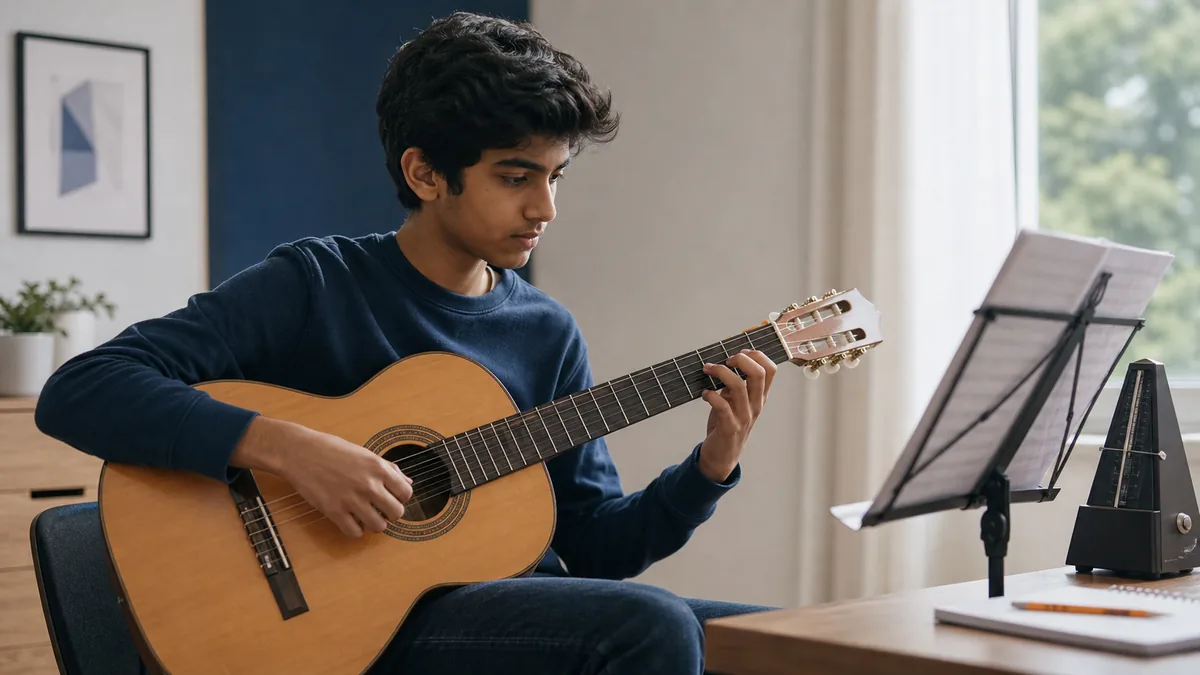
A Trinity College London guitar exam can give practice a clear target, but the certificate should not become the only reason to play. The best preparation develops rhythm, technique, listening and performance confidence alongside the exam pieces.
Before buying a book or booking an exam, confirm the exact pathway. Trinity lists separate options for classical guitar, acoustic guitar and Rock and Pop guitar. The music and assessment format are not interchangeable.
Initial Grade or Grade 1?
Trinity describes Initial Grade as an introductory level for beginners. Grade 1 is the first full grade and assumes a little more technical and musical experience. A teacher should assess the student against the current syllabus rather than choosing by age.
Understanding the Rock and Pop format
For Trinity Rock and Pop Guitar Grade 1, the official structure uses three songs. The current official page assigns 25 marks to Song 1, 25 marks to Song 2 and 30 marks to the technical focus song. The remaining 20 marks relate to session skills and overall performance, depending on whether the exam is face-to-face or digital.
Face-to-face candidates choose playback or improvising for the session skill. In the digital format, the underlying skills are assessed across the performance. Always check the latest official syllabus because set lists, rules and resources can change.
How long does preparation take?
There is no fixed number of months. A complete beginner may need longer because the exam pieces sit on top of basic technique and rhythm. A student who already plays songs confidently may be ready sooner.
Use a mock performance to decide. If the student can play all required material without restarting, recover after small mistakes and meet the technical requirements, the exam date is becoming realistic.
A balanced weekly plan
- Work on small sections of each piece instead of playing every song from beginning to end.
- Practise with the official backing tracks when the syllabus requires them.
- Keep technique work connected to the difficult passages in the music.
- Record a full performance once a week.
- Include listening, rhythm and session-skill practice, not only note learning.
Common mistakes
The most serious mistake is booking the wrong subject or syllabus. Trinity's support guidance warns candidates to match the exact instrument and syllabus name, such as Acoustic Guitar, Classical Guitar or Rock and Pop Guitar.
Other problems include choosing an exam date too early, ignoring backing-track rules, practising only from the start of each song and leaving performance practice until the final week.
Does every student need a grade exam?
No. Some students are more motivated by songs, composition, bands or live performance. An exam is useful when the structure supports the student's goal. It is less useful when preparation removes every piece of music they enjoy.
Preparation at Jam And Play
Jam And Play supports Trinity grade preparation for guitar and other instruments through structured lessons, mock evaluations and performance work. The starting grade and timeline should follow the student's current level, not a sales promise.
Source: Official Trinity Grade 1 Guitar page
Source: Trinity guidance on booking the correct exam and grade
Book an assessment to discuss the right Trinity pathway and preparation plan. Book a free demo
Want a clearer first step?
Meet a mentor, talk about what you want to play and get a learning plan built around your schedule.