How to tune a guitar for beginners: a pre-practice guide
Learn standard guitar tuning, read sharp and flat indicators, and follow a simple tuning checklist before practice or your next online guitar lesson.
19 October 20265 min read
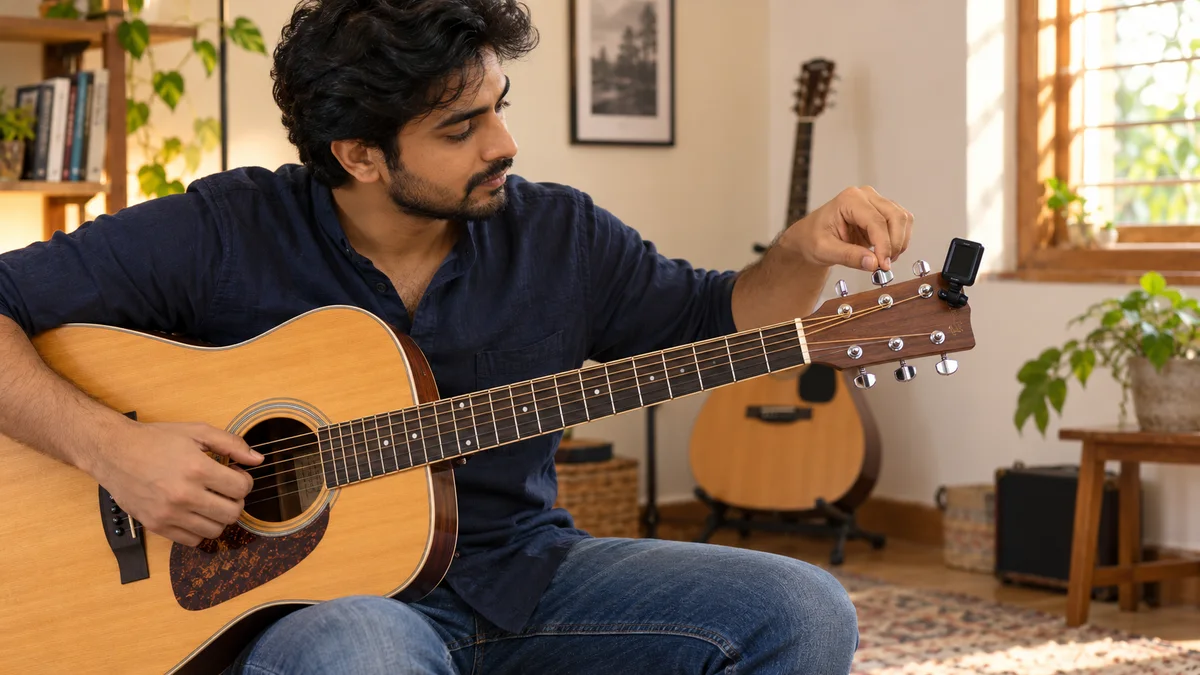
Before deciding that your chord shape is wrong, check your tuning. A beginner can place every finger correctly and still hear an unsettled chord if one open string is out of tune. This guide gives you a repeatable starting routine for a six-string guitar in standard tuning, whether you practise in Udaipur or join lessons online from abroad.
Know the six target notes first
Standard tuning runs E–A–D–G–B–E from the thickest string to the thinnest. The thickest is string 6, the low E; the thinnest is string 1, the high E. These two E strings have the same letter name but different pitches. Fender’s beginner tuner guide recommends starting at the low E and working across to the high E.
- String 6: E — the thickest string.
- String 5: A.
- String 4: D.
- String 3: G.
- String 2: B.
- String 1: E — the thinnest string.
Check Fender’s standard-tuning reference
Prepare your tuner before turning a peg
Choose standard six-string guitar tuning in your app or tuner if it offers a preset. Remove the capo for this routine. Pluck an open string without holding down a fret. Trace that string along the neck to its tuning post so you know which key controls it; do not guess from the position of the key alone.
A tuner reading needs two checks: the note name must match your target, and the pitch indicator must show that note in tune. A centred indicator on the wrong note is not a successful result. If your tuner displays octave numbers, standard tuning from string 6 to string 1 is E2, A2, D3, G3, B3, E4. Do not keep tightening a string just to find another E; ask your teacher if you are unsure of the octave.
Make small adjustments and listen again
Pluck one string and let the reading settle. Flat means below the target pitch; sharp means above it. Make a small adjustment to the correct tuning key, pluck again and check whether the pitch moved in the intended direction. Tightening raises pitch and loosening lowers it, but the apparent turning direction depends on the headstock and how the string is wound.
Move gradually rather than making several large turns while watching the display. Once all six strings are close, check them again in the same order. This routine is for ordinary tuning adjustments on a strung guitar. A loose, newly installed string or an instrument that seems far from the expected pitch is a good reason to get guidance before continuing.
If the app cannot hear the string
Fender’s troubleshooting advice recommends a quiet environment, a stable device position near the instrument and time for each plucked note to ring. For an electric guitar picked up through a phone microphone, it recommends a clean amplified sound without distortion. Stop a backing track or conversation before checking the tuner again.
Read Fender’s tuning-app troubleshooting advice
Treat an unstable reading as a question to investigate, not an instruction to keep turning. Check microphone permission, the selected instrument mode and which string is sounding. During an online lesson, tell your teacher what the tuner displays as well as what you hear. A clear description such as “the A string keeps being detected as G” is more useful than “the app is broken”.
Use a short pre-lesson checklist
- Open your tuner before the video call, leaving enough time to ask for help if a reading is confusing.
- Say each target note aloud as you work from string 6 to string 1.
- Recheck the six open strings, then play one familiar chord slowly.
- If the chord still sounds wrong, distinguish an out-of-tune pitch from a muted or buzzing string.
- Write down the string and the symptom if the same problem returns. Bring that observation to your teacher.
Troubleshoot buzzing or muted guitar chords
How often should a beginner check tuning?
Make a tuning check part of the beginning of each practice session, and check again if something sounds different. Fender identifies temperature and humidity changes, handling a guitar in its case and changing strings as reasons tuning can shift. A check is useful even when nobody has deliberately turned the keys.
Read Fender’s acoustic-guitar tuning overview
Keep this separate from learning a song: first establish the open-string tuning, then work on rhythm and chord changes. If one string repeatedly drifts or open strings seem correct while fretted notes consistently sound wrong, describe that pattern to your teacher or a guitar technician. Repeatedly retuning is not a substitute for finding the cause.
Plan a focused 20-minute guitar practice session
Get help with your first tuning routine
Bring your guitar and the tuner you actually use to a Jam Start 90 session. Ask the teacher to check your string names, tuning-key identification and reading of the display. The aim is a routine you can repeat independently before your next lesson, rather than relying on someone else to tune every time.
Want a clearer first step?
Meet a mentor, talk about what you want to play and get a learning plan built around your schedule.