How to Choose an Online Music Teacher: 10 Questions to Ask Before You Pay
Ten questions to ask an online music teacher before you pay, what to watch for in a trial lesson, and the red flags that mean you should keep looking.
20 November 20266 min read
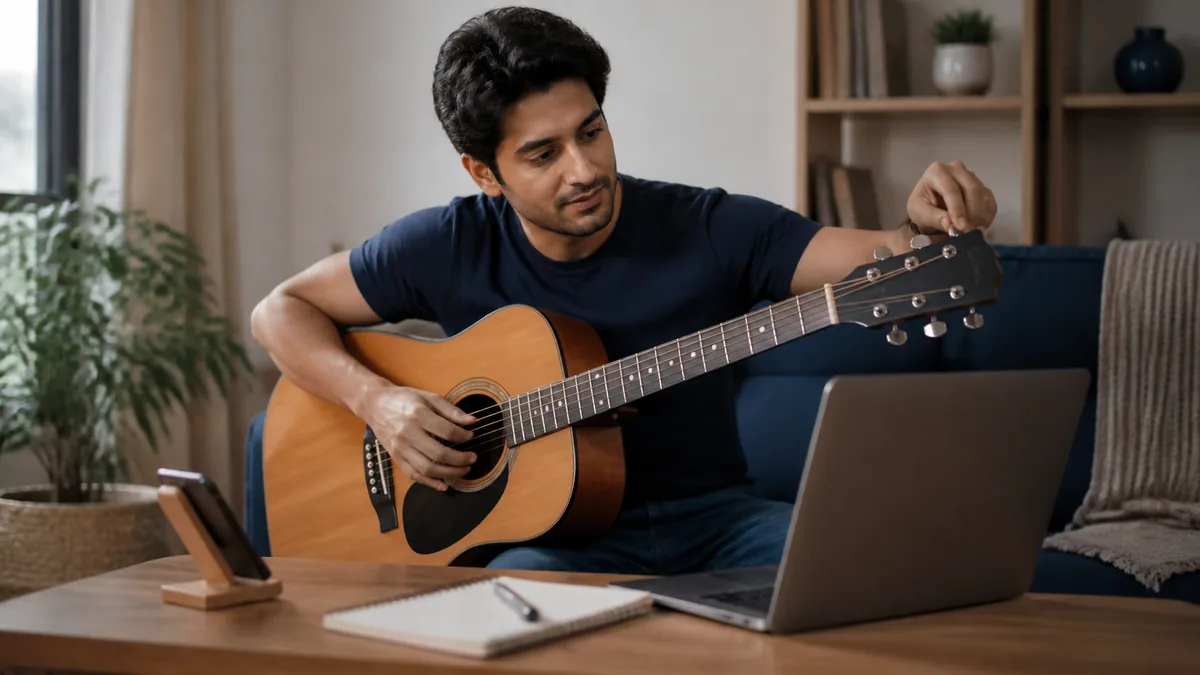
Quick answer: Choose an online music teacher by what happens in a trial lesson, not by their credentials alone. A good teacher asks about your goals first, corrects something specific within the first ten minutes, can see your hands clearly, and ends with a practice plan and a picture of the next three months. Then check the practical side: lesson length, price per lesson, rescheduling and whether there’s a lock-in.
Most people choose a music teacher on price or on how well the teacher plays. Neither tells you whether they can teach you. Here’s how to find out before you pay.
Start with your goal
The right teacher depends on what you want:
| Your goal | Look for a teacher who… |
|---|---|
| Play favourite songs for fun | Teaches through songs you choose and simplifies them for your level |
| Hindi and Bollywood songs | Knows the repertoire and can arrange it for your instrument |
| Graded exams (Trinity, Rockschool) | Has prepared students for that board and grade before |
| A child’s first lessons | Has patience, short activities and experience with that age |
| Returning after a long break | Starts with a skills check, not from page one |
| Band or performance | Plays in that style and teaches timing and playing with others |
10 questions to ask before you pay
About the teaching
- What would you teach me in the first month? A good teacher gives specifics: a chord set, a song, a technique. “It depends” with nothing after it is a weak answer.
- How do you correct technique online? Listen for camera angles, slowing things down and asking you to repeat, not just “I’ll watch”.
- Can I learn songs I choose? Your motivation rises when you play music you love.
- What do you give me between lessons? You should leave every lesson knowing exactly what to practise and for how long.
- Have you taught students like me? Same age group, same goal, same level.
About the logistics
- How long is each lesson, and how many a month?
- What happens if I miss a lesson? Ask about notice periods and make-ups.
- Which platform do you use, and when do you teach? This matters across time zones.
About the money
- What does it cost per lesson, and is there a joining fee, lock-in or refund policy?
- Can I try a lesson first?
You don’t need to ask all ten at once. Ask the money and logistics questions before booking a trial; save the teaching questions for the trial itself.
Green flags in a trial lesson
- The teacher asks about your goals and the music you like before teaching anything.
- You play something within the first ten minutes.
- They correct one specific thing, such as thumb position or rhythm, and you hear the difference.
- They check your camera so they can see your hands.
- You leave with a short, written practice plan.
- They describe what the next few months could look like.
Red flags
- No trial lesson and a demand for months of fees upfront.
- A lock-in or long contract before you’ve had a few lessons.
- The same curriculum for everyone, whatever your goal.
- No corrections, just “good, carry on”.
- Poor audio or video on the teacher’s side that doesn’t improve.
- Pressure to buy expensive gear in the first lesson.
- Frequent cancellations by the teacher.
Does the teacher need certificates?
Certificates and degrees show training, and exam-board experience matters if you’re preparing for exams. But a brilliant performer is not automatically a good teacher, and plenty of excellent teachers learned by playing and teaching for years. Weigh three things together: what they say about how they teach, what you experience in the trial, and what other students say in reviews.
Independent teacher, platform or academy?
| Option | Strengths | Watch for |
|---|---|---|
| Independent teacher | Personal attention, flexible | Cover when they’re ill or away; payment protection |
| Tutor platform or marketplace | Many choices, reviews in one place | Quality varies widely by tutor |
| Music academy | Structured curriculum, cover teachers, exam routes | Some lock you into long plans |
How Jam and Play answers these questions
So you can compare like for like, here’s how we work:
| Question | Our answer |
|---|---|
| Trial lesson | Free 30-minute demo |
| Lesson length | 45 minutes, live, one-to-one or a shared 2:1 batch |
| Fees | From ₹3,999 for four one-to-one lessons; ₹3,200 for a 2:1 batch (pricing) |
| Joining fee or lock-in | None; pay month to month |
| Between lessons | A practice plan of 15–20 minutes a day |
| Missed lessons | One-to-one students can reschedule more flexibly; make-ups in shared batches are limited |
| Switching format | Between one-to-one and 2:1 at the start of any month, subject to availability |
| Exams | Trinity preparation included in one-to-one plans |
| Teaching hours | 9 am to 10 pm India Standard Time |
View current lesson plans and pricing
For more on lesson formats, see one-to-one vs group online classes and how online guitar lessons work.
One-to-one vs group online classes
How online guitar lessons work
FAQ
How do I know if a music teacher is good?
In a trial lesson, a good teacher asks about your goals, corrects something specific, and gives you a clear practice plan. After a month, you should be able to hear your own progress.
Is an online music teacher as good as an in-person one?
For most students, yes, if the lessons are live and the teacher can see your hands. In-person can suit very young children better.
How many trial lessons should I take before deciding?
One is usually enough to judge teaching style. If you’re unsure, try one or two other teachers and compare.
When should I change teachers?
If you’re not hearing progress after two or three months, or you dread lessons, talk to the teacher first. If nothing changes, it’s fair to move on.
Test us with your own questions
Bring these ten questions to a free 30-minute demo with Jam and Play and see how we answer them.
Want a clearer first step?
Meet a mentor, talk about what you want to play and get a learning plan built around your schedule.