Drum Classes in India: Fees, Online vs Studio, and Do You Need a Kit at Home?
What drum classes cost in Indian cities, whether online drum lessons work, and what you need at home: practice pad, electronic kit or acoustic kit.
18 November 20267 min read
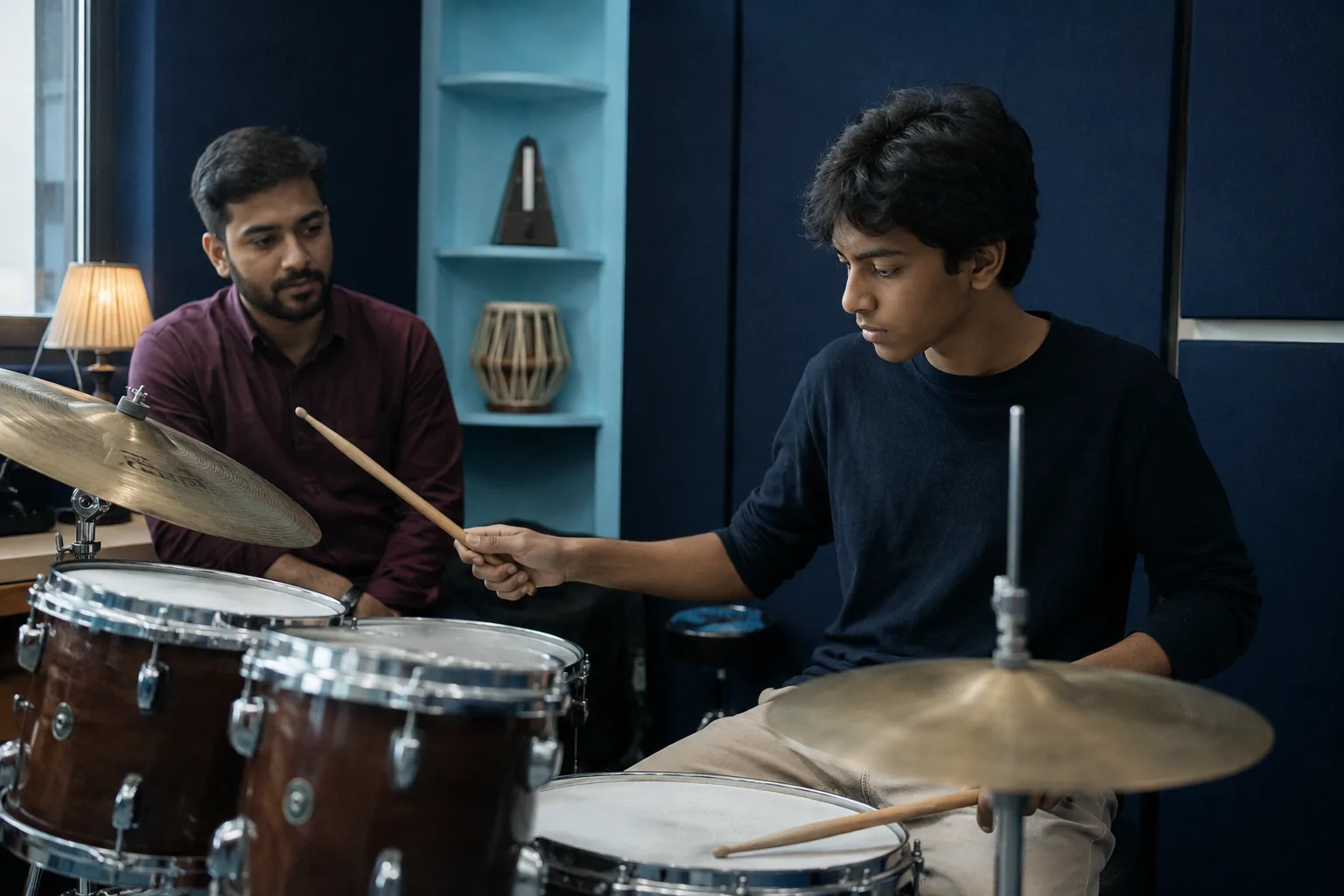
Quick answer: Superprof’s listed averages for private drum tutors in four Indian cities ran from about ₹880 to ₹1,070 an hour when checked in November 2026. As an academy example, Path of Music in Gurugram lists ₹4,000 a month for 4–6 classes. You can start drums online with just sticks and a practice pad; within a few months you’ll want a kit, and an electronic kit is the usual choice in flats.
Drums raise questions other instruments don’t: the noise, the space, the cost of the kit, and whether a teacher can really help through a screen. Here’s how it works in practice.
What drum classes cost in Indian cities
Average hourly rates for private drum tutors listed on Superprof India, November 2026:
| City | Average per hour |
|---|---|
| Bengaluru | ₹881 |
| Gurugram | ₹935 |
| New Delhi | ₹965 |
| Pune | ₹1,069 |
Superprof listings for Bengaluru
Superprof listings for Gurugram
Superprof listings for New Delhi
These are averages for tutors listed on Superprof in each city. Ask individual teachers about lesson length and whether their rate covers online, studio or home tuition.
Academy examples
| Provider | What’s published |
|---|---|
| Path of Music (Gurugram) | ₹4,000 for 4–6 classes a month; online and offline; minimum age 6; Rockschool exam fees separate |
| Furtados School of Music | A 16-session beginner online drum course covering single strokes, double strokes, paradiddles and basic grooves |
| Jam and Play | Published guitar plans start at ₹3,999 for four 45-minute lessons. Ask for a drum lesson quote. A free 30-minute demo is available. |
Furtados School of Music’s drum course
Jam and Play’s published guitar plans
Online or in a studio?
| Feature | Online drum lessons | Studio lessons |
|---|---|---|
| What you need at home | Pad and sticks to start; a kit later | Nothing at first; the studio has a kit |
| Travel | None | Every class |
| Feedback | Good with the right camera angle (side view of hands and feet) | Teacher can adjust your grip and posture directly |
| Practice between classes | At home, on your own pad or kit | Still needs a pad or kit at home |
| Best for | Busy adults, students outside big cities, NRIs | Young children, people with no space for a kit yet |
Online drum lessons work better than people expect, because most early drumming is about grip, timing and coordination, which a teacher can see clearly on camera. With either format, you’ll eventually need a pad or kit to practise on at home.
Do you need a drum kit at home?
Not on day one. Think of it in three stages:
Stage 1: sticks, a practice pad and a metronome (first 4–8 weeks). Enough to learn grip, single and double strokes, counting and simple beats. Pads are quiet and cheap; one Gurugram academy quotes ₹500–₹1,000 for a basic pad.
Stage 2: an electronic kit (from around month 2 or 3). Once you’re coordinating hands and feet, a pad isn’t enough. Electronic kits work with headphones, fit in a corner and keep neighbours happy, which is why they’re the usual choice in Indian flats.
Stage 3: an acoustic kit (if you have the space). Louder, more expressive and better for building dynamics, but it needs a room and tolerant neighbours.
New to drums? Start with how to play drums for beginners: the parts of the kit, how to hold the sticks and your first three beats.
How to play drums for beginners
What the first three months usually cover
| Month | Typical focus |
|---|---|
| 1 | Grip, posture, single and double strokes, counting eighth notes |
| 2 | Basic rock beat, bass drum and hi-hat coordination, reading simple rhythm |
| 3 | Fills, a second groove, playing along with a slow song |
That matches what structured beginner courses publish: rudiments, reading basic note values and hand-foot coordination before songs.
Drum classes for kids
Most children can start drums around age 6 to 8, when they can reach the pedals or play a smaller kit. Some academies set 6 as the minimum. Young children often do well starting on a pad for a few weeks before moving to a kit, and short 30–45 minute classes work best.
Costs on top of the class fee
- Sticks (you’ll break and lose them).
- A practice pad and stand.
- A kit, electronic or acoustic, by month 2 or 3.
- Hearing protection for acoustic kits.
- Exam fees for Trinity or Rockschool, paid to the exam board.
Questions to ask before you join
- Can I start online with only a pad, and when will I need a kit?
- How long is each class, and how many a month?
- Will the teacher check my camera set-up so they can see my feet?
- Is there a joining fee or lock-in?
- Do you prepare students for Trinity or Rockschool exams?
FAQ
Can I learn drums online without a drum set?
Yes, for the first few weeks, using sticks, a practice pad and a metronome. You’ll need a kit, usually electronic, once you start coordinating hands and feet.
How much are drum classes per month in India?
Path of Music in Gurugram lists ₹4,000 a month for 4–6 classes. Superprof’s listed averages in Bengaluru, Gurugram, New Delhi and Pune range from about ₹880 to ₹1,070 an hour.
What age can a child start drum lessons?
Usually around 6 to 8, depending on reach and attention span.
Is an electronic drum kit good for learning?
Yes. It’s quieter, smaller and practical for flats, and it’s what many beginners in Indian cities learn on.
Start with a free demo
A demo shows whether online drum lessons suit you before you buy anything. Book a free 30-minute demo for Jam and Play’s drum classes, online or at our Udaipur studio.
Want a clearer first step?
Meet a mentor, talk about what you want to play and get a learning plan built around your schedule.