How to Play Drums for Beginners: Your First 3 Beats, Step by Step
Learn to play drums from zero: the parts of a drum set, how to hold sticks, how to count, and three basic drum beats with simple grids and target speeds.
13 November 20267 min read
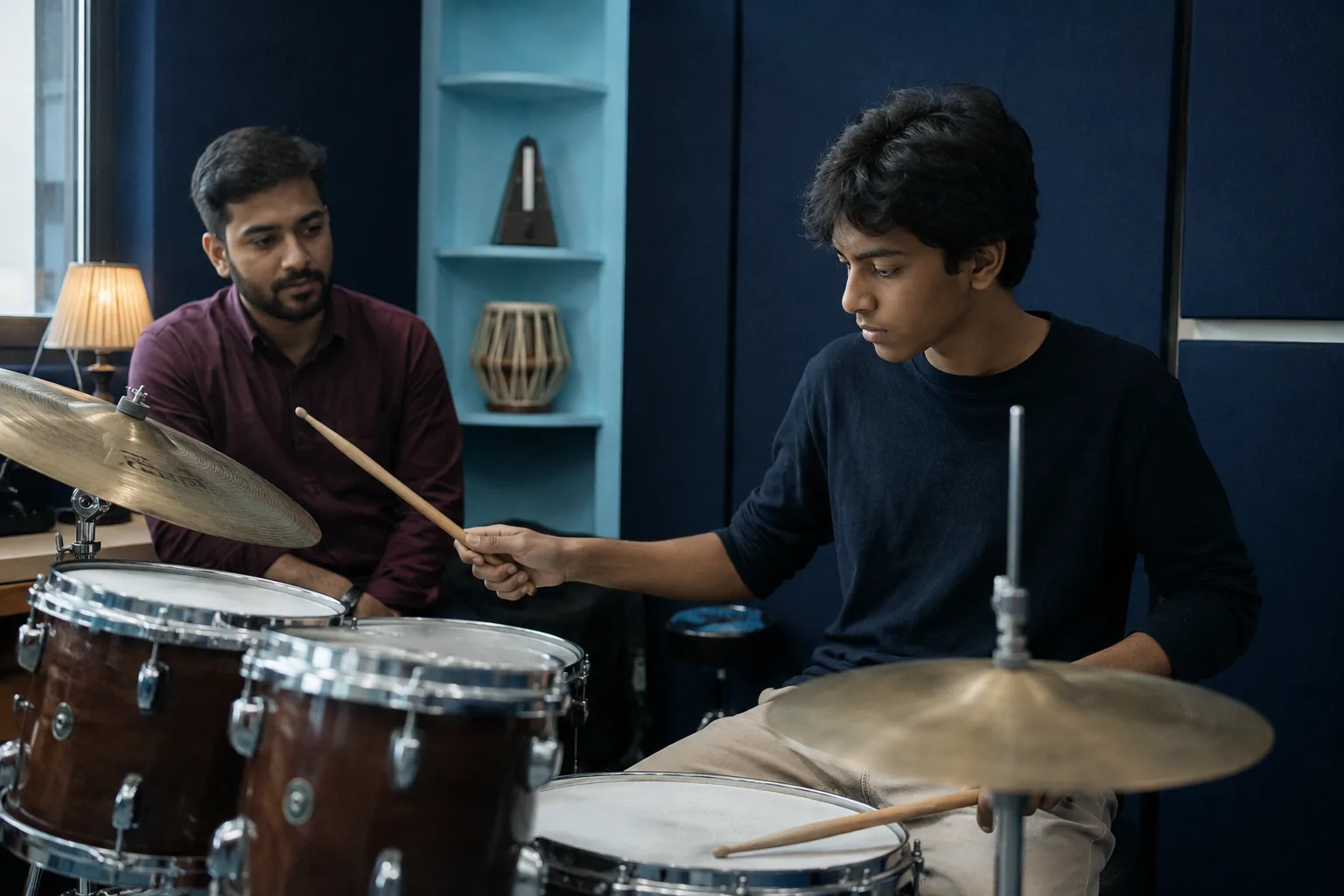
Quick answer: To play drums as a beginner, learn four things in order: the parts of the kit, how to hold the sticks, how to count in eighth notes, and one basic rock beat. That beat is hi-hat on every eighth note, bass drum on beats 1 and 3, and snare on beats 2 and 4. Practise it slowly with a metronome at 60 BPM. You don’t need a full kit to start; a practice pad and a pair of sticks are enough.
That single beat sits under a huge share of pop, rock and film songs. Learn it properly and you’re already playing music.
The parts of a drum set
| Part | Played with | What it does |
|---|---|---|
| Bass drum (kick) | Right foot, on a pedal | The low “boom”, usually on the main beats |
| Snare drum | Sticks, between your knees | The sharp “crack” on the backbeat |
| Hi-hat | Sticks, plus a pedal under your left foot | Two cymbals that keep time; foot closes them |
| Toms (high, mid, floor) | Sticks | Used for fills between sections |
| Crash cymbal | Sticks | Loud accent, often at the start of a section |
| Ride cymbal | Sticks | Steady pattern, an alternative to the hi-hat |
Left-handed drummers often set the kit up mirrored. Either way works; be consistent.
What you need to start
- Sticks. 5A is the standard all-round size for beginners.
- A practice pad. Quiet, cheap and enough for your first weeks of grip and rhythm work.
- A metronome. Any free app.
- Ear protection. An acoustic kit is loud enough to damage hearing over time. Use proper musicians’ earplugs.
- A kit, eventually. In flats and apartments, many learners choose an electronic kit for the volume control and headphones.
No kit yet? Your thighs or a firm cushion work as a stand-in for learning beats: right hand for the hi-hat, left hand for the snare, and tap your right foot for the bass drum.
Step 1: Sit and set up properly
Adjust the stool (called a throne) so your thighs are level or slope slightly down toward your knees. Your right foot rests on the bass drum pedal and your left on the hi-hat pedal. The snare sits between your knees, a little below your waist. If you have to reach or hunch, adjust the kit, not your back.
Step 2: Hold the sticks
Most beginners learn matched grip: both hands hold the sticks the same way.
- Find the balance point, about a third of the way up from the bottom (butt) end.
- Pinch the stick there between your thumb and the first joint of your index finger. This pinch point is the fulcrum.
- Wrap your other fingers loosely around the stick. Don’t squeeze.
- Turn your palms to face the floor.
- Let the stick bounce off the drum. Strike down, then let it rebound back up.
What goes wrong: gripping too tightly. A tight grip kills the bounce, tires your forearms and makes the drums sound choked.
Step 3: Learn to count
Drum beats are counted in eighth notes: 1 & 2 & 3 & 4 &, with each number and each “&” getting an equal share of time. Say it out loud with a metronome at 60 BPM, one click per number. Every beat below is written on this count.
In the grids below, x means hit the hi-hat, o means hit the drum, and . means rest.
Beat 1: The basic rock beat
Count   1  &  2  &  3  &  4  &
Hi-hat  x  x  x  x  x  x  x  x
Snare   .  .  o  .  .  .  o  .
Kick    o  .  .  .  o  .  .  .
Build it in layers:
- Play only the hi-hat: eight even hits per bar, right hand.
- Add the kick on 1 and 3. The kick lands at the same moment as the hi-hat.
- Add the snare on 2 and 4 with your left hand, again together with the hi-hat.
Target: 60 BPM for four bars without stopping, then speed up by 5 BPM at a time.
Beat 2: Add a kick on the “&” of 3
Count   1  &  2  &  3  &  4  &
Hi-hat  x  x  x  x  x  x  x  x
Snare   .  .  o  .  .  .  o  .
Kick    o  .  .  .  o  o  .  .
One extra kick makes the beat push forward. The extra kick lands with the hi-hat on the “&” of 3. Practise slowly until both hits line up.
Beat 3: Four on the floor
Count   1  &  2  &  3  &  4  &
Hi-hat  x  x  x  x  x  x  x  x
Snare   .  .  o  .  .  .  o  .
Kick    o  .  o  .  o  .  o  .
The kick plays on every beat, the steady pulse of dance and disco music. On beats 2 and 4, the kick, snare and hi-hat all land together.
Your first fill
A fill is a short pattern that leads into the next section. Play three bars of Beat 1, then in the fourth bar:
- Play Beat 1 for beats 1, 2 and 3.
- On beat 4, play four even snare hits: “4 e & a”.
- Hit the crash cymbal together with the kick on the next “1”.
That’s the four-bar loop most songs are built on.
Three warm-ups for your hands
Drummers call these rudiments. Play them on a pad for two minutes each:
| Rudiment | Sticking | Builds |
|---|---|---|
| Single stroke roll | R L R L R L R L | Even hands |
| Double stroke roll | R R L L R R L L | Control and bounce |
| Paradiddle | R L R R L R L L | Coordination |
Start at 60 BPM and keep every hit the same volume.
A 4-week plan
| Week | Focus (20 minutes a day) |
|---|---|
| 1 | Grip and single strokes on a pad; count 1 & 2 & aloud; Beat 1 hands only |
| 2 | Beat 1 with kick at 60–70 BPM; double strokes |
| 3 | Beat 2; first fill; paradiddles |
| 4 | Beat 3; switch between all three beats every four bars; play along with a slow song |
If you want to compare drums with other instruments before committing, read which instrument a beginner should learn first.
FAQ
Can I learn drums without a drum set?
Yes, to start. Use a practice pad and sticks for grip and rudiments, and tap beats on your legs with your foot keeping the kick. You’ll need a kit, acoustic or electronic, once you’re working on coordination between hands and feet.
What is the easiest drum beat for beginners?
The basic rock beat: hi-hat on every eighth note, bass drum on beats 1 and 3, and snare on 2 and 4.
Which drumsticks should a beginner buy?
5A is the standard all-round size for most beginners. Players with smaller hands sometimes prefer 7A.
How long does it take to learn basic drum beats?
With 20 minutes of daily practice, most beginners can play a steady basic rock beat within a couple of weeks.
Can I play drums in an apartment?
An electronic kit with headphones is the usual answer. Practice pads are quiet enough for any home.
Learn drums with a teacher
A teacher spots grip and timing problems you can’t hear yourself and builds your coordination step by step. Jam and Play’s one-to-one drum classes run online and at our Udaipur studio. Book a free 30-minute demo.
Want a clearer first step?
Meet a mentor, talk about what you want to play and get a learning plan built around your schedule.