How to Hold a Guitar Pick: The Right Grip for Strumming and Picking
The right grip for strumming and picking: how much tip to show, how tight to grip, and how to stop your pick slipping.
29 October 20268 min read
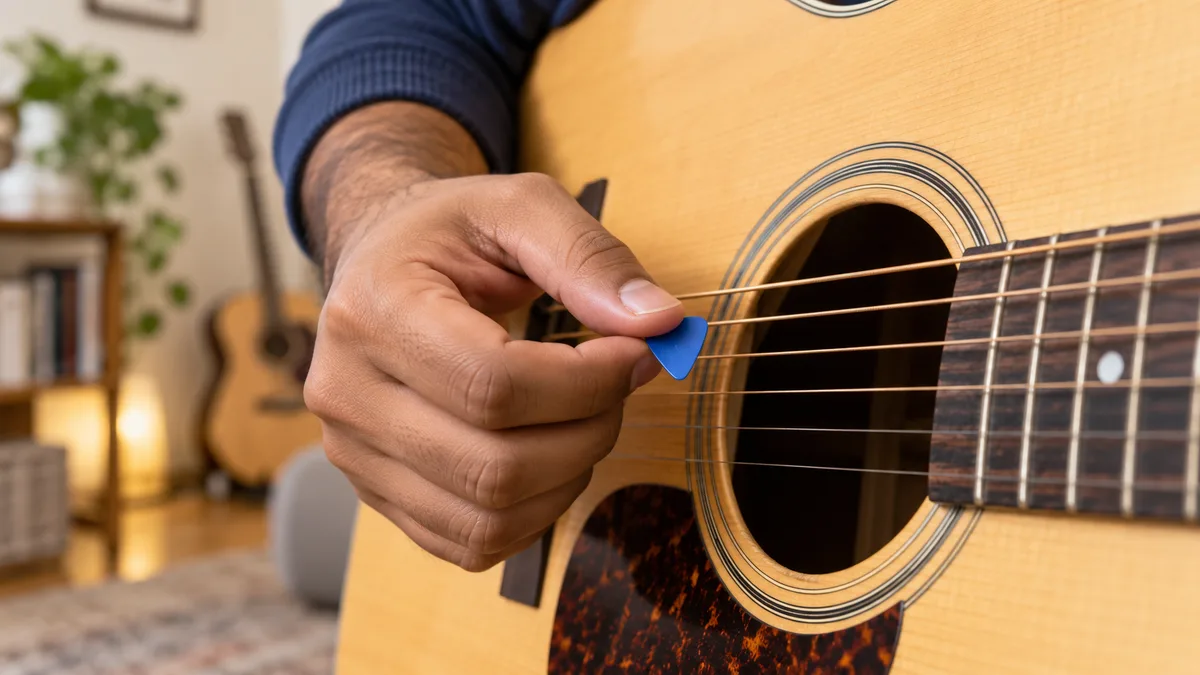
Rest the pick on the side of your index finger, near the first joint, with the point aiming away from your hand. Press the pad of your thumb on top so only 2–3 mm of the tip shows. Grip just firmly enough that the pick doesn’t turn when it hits a string. For strumming, loosen slightly and let a little more tip show.
That grip works for most players in most styles. The rest of this guide covers how to tell if it’s right, what to change for strumming, and how to stop the pick sliding out of your fingers mid-song (one of the most common beginner questions).
How to hold a guitar pick in 5 steps
- Make a loose fist with your strumming hand, then relax it so the index finger curls gently, like you’re holding a cup handle. Your thumb points along the side of your index finger.
- Lay the pick flat on the side of your index finger, on the part between the tip and the first joint. The pointed end faces away from your palm, at a right angle to your thumb.
- Bring your thumb pad down on top of the pick. Your thumb lies roughly along the length of your index finger, not crossing it at an angle.
- Check the tip. About 2–3 mm should poke out past your thumb for single notes. For strumming, 4–5 mm is fine.
- Let the other three fingers relax. They can curl into your palm or hang loosely. Don’t clench them, and don’t press them hard against the guitar.
What goes wrong most often is step 2. If the pick sits on the flat pad of your index finger instead of the side, you’ve made the “pinch” grip. It isn’t wrong, but it gives less control for beginners, and the pick tends to flip.
How tight should you hold a pick?
Looser than you think. Try this test: hold the pick with your normal grip and ask someone to pull it gently out of your fingers. It should resist, then slide out with a light tug. If they can’t move it, you’re gripping too hard. If it drops when they touch it, too soft.
A death grip tires your hand within minutes and makes your strumming sound harsh. Your grip will tighten a little when you pick single notes and loosen a little when you strum. That flexing is normal, and you’ll stop noticing it within a few weeks.
Holding a pick for strumming vs picking single notes
The grip stays the same. Three small things change.
| Strumming chords | Picking single notes | |
|---|---|---|
| Tip showing | 4–5 mm | 2–3 mm |
| Grip pressure | Lighter, pick can flex slightly | Firmer, pick stays fixed |
| Movement | From the wrist and forearm, like shaking water off your hand | Small movement from the wrist or thumb and index finger |
| Pick angle | Tilted slightly so it glides across all strings | Close to flat against the string |
If your strums catch or “snag” on the strings, tilt the pick a little so its edge leads, about 15–30 degrees. It will slide through the strings instead of hitting each one head-on. Our beginner strumming patterns guide shows the arm motion.
Three common pick grips compared
| Grip | How it works | Good for | Watch out for |
|---|---|---|---|
| Standard (side of index finger) | Pick on the side of the curled index finger, thumb on top | Beginners, strumming and lead, most styles | Too much tip showing |
| Pinch | Pick held between the pad of the thumb and the pad of the index finger | Light strumming with a thin pick | Pick rotates and flips more easily |
| Fist or closed | All fingers curled, pick held against the side of the index finger | Heavy picks, loud acoustic strumming, fast picking | Can feel stiff at first |
Start with the standard grip. If after a couple of months your teacher sees you naturally drifting to another one and it sounds good, that’s fine. Plenty of famous players hold the pick in unusual ways, including between the thumb and middle finger.
6 pick-holding mistakes and how to fix them
- Too much pick showing. It flaps against the strings and sounds sloppy. Fix: choke up until 2–3 mm shows.
- Too little showing. Your thumb or finger skin hits the strings. Fix: let a bit more tip out.
- Gripping too hard. Your forearm aches and strums sound harsh. Fix: do the tug test above, then shake out your hand between songs.
- The pick turns sideways mid-song. Usually the pick is on the pad of your finger instead of the side, or your grip is too loose. Fix: reset to step 2 and check every few minutes until it’s automatic.
- Clenched spare fingers. Tension spreads into your wrist. Fix: let them hang or curl loosely.
- Moving the whole arm from the shoulder. You’ll tire fast and lose rhythm. Fix: move from the wrist and forearm; keep your elbow fairly still.
For more beginner habits worth fixing early, see our list of beginner guitar mistakes.
How to stop your pick from slipping
A slipping pick is normal in the first few weeks. If it’s still happening after a month, one of these usually solves it:
- Use a textured or matte pick. Smooth, shiny picks slide the most. Matte and textured picks grip better, especially in humid weather or when your hands sweat.
- Try a slightly thicker pick. Very thin picks bend on every strum and work their way out of your fingers.
- Check where it sits. On the side of your index finger it stays put. On the fingertip pad, it spins.
- Dry your hands before you play, and keep a small cloth nearby in summer.
- Picks with holes or grip patches help some players. They’re worth a try, not a requirement.
Which pick thickness should a beginner buy?
Picks are sold by thickness in millimetres:
| Thickness | Range | Feels | Best for |
|---|---|---|---|
| Thin | under 0.6 mm | Floppy, bright sound | Light acoustic strumming |
| Medium | 0.6–0.8 mm | Some flex, balanced | Beginners doing a bit of everything |
| Heavy | 0.9–1.2 mm | Stiff, fuller sound | Single notes, riffs, solos |
| Extra heavy | above 1.2 mm | Very stiff | Fast lead, jazz |
Our advice: buy a mixed pack with a few of each and try them for a week. Most beginners settle on a medium pick for strumming songs and move toward heavier picks as they start playing riffs. Picks are cheap and easy to lose, so keep spares in your guitar case.
Should you use a pick or your fingers?
Both are correct. A pick gives a brighter, louder strum and is standard for rock, pop and most electric guitar playing. Fingers give a softer sound and let you play bass notes and melody together, which is why fingerstyle players skip the pick.
Many beginners learning Hindi songs on acoustic guitar start with a pick for strumming, then add fingerpicking for intros and slow songs. You don’t have to choose forever on day one.
Three drills to make the grip automatic
Set a metronome to 60 BPM and do these for five minutes a day:
- Open-string down strokes: four down strokes on each string, from the thick E string to the thin e and back. Watch that the pick hasn’t moved in your fingers at the end.
- Down-up on one string: play down-up-down-up on the open G string, one stroke per click, then two per click.
- Strum an E minor chord with four down strokes per bar for one minute. Then check the tip length. If it’s grown or shrunk, reset and go again.
Add these to your 20-minute practice routine as the warm-up.
FAQ
What is the correct way to hold a guitar pick?
Rest it on the side of your curled index finger, press it down with your thumb pad, and let 2–3 mm of the tip show. Hold it firmly enough that it doesn’t turn, but loosely enough that a light tug would pull it out.
How much of the pick should stick out?
About 2–3 mm for single notes and 4–5 mm for strumming. More than that and the pick flaps against the strings; less and your skin catches them.
Why does my guitar pick keep slipping?
Usually the pick is on the pad of your finger instead of the side, the grip is too loose, or the pick is very thin and smooth. A matte or textured medium pick held on the side of the index finger fixes most cases.
Is it wrong to hold a pick with three fingers?
No, but it’s harder to keep the tip length consistent. Some players use the thumb, index and middle finger for extra stability. Try the standard two-finger grip first.
How do left-handed players hold a pick?
Exactly the same way, mirrored. The pick goes in whichever hand strums.
Get your grip checked in a free demo
A pick grip is one of those things that’s hard to judge on yourself and takes a teacher about ten seconds to correct. In a free 30-minute demo lesson, live online or at our Udaipur studio, your teacher can watch your strumming hand and fix the grip before it becomes a habit. See our acoustic guitar classes for what comes next.
Want a clearer first step?
Meet a mentor, talk about what you want to play and get a learning plan built around your schedule.