Online guitar classes for NRI beginners in the USA: a practical guide
Explore online guitar classes for NRI beginners in the USA, with practical advice on lesson timing, home setup, song choices and weekly practice.
September 20266 min read
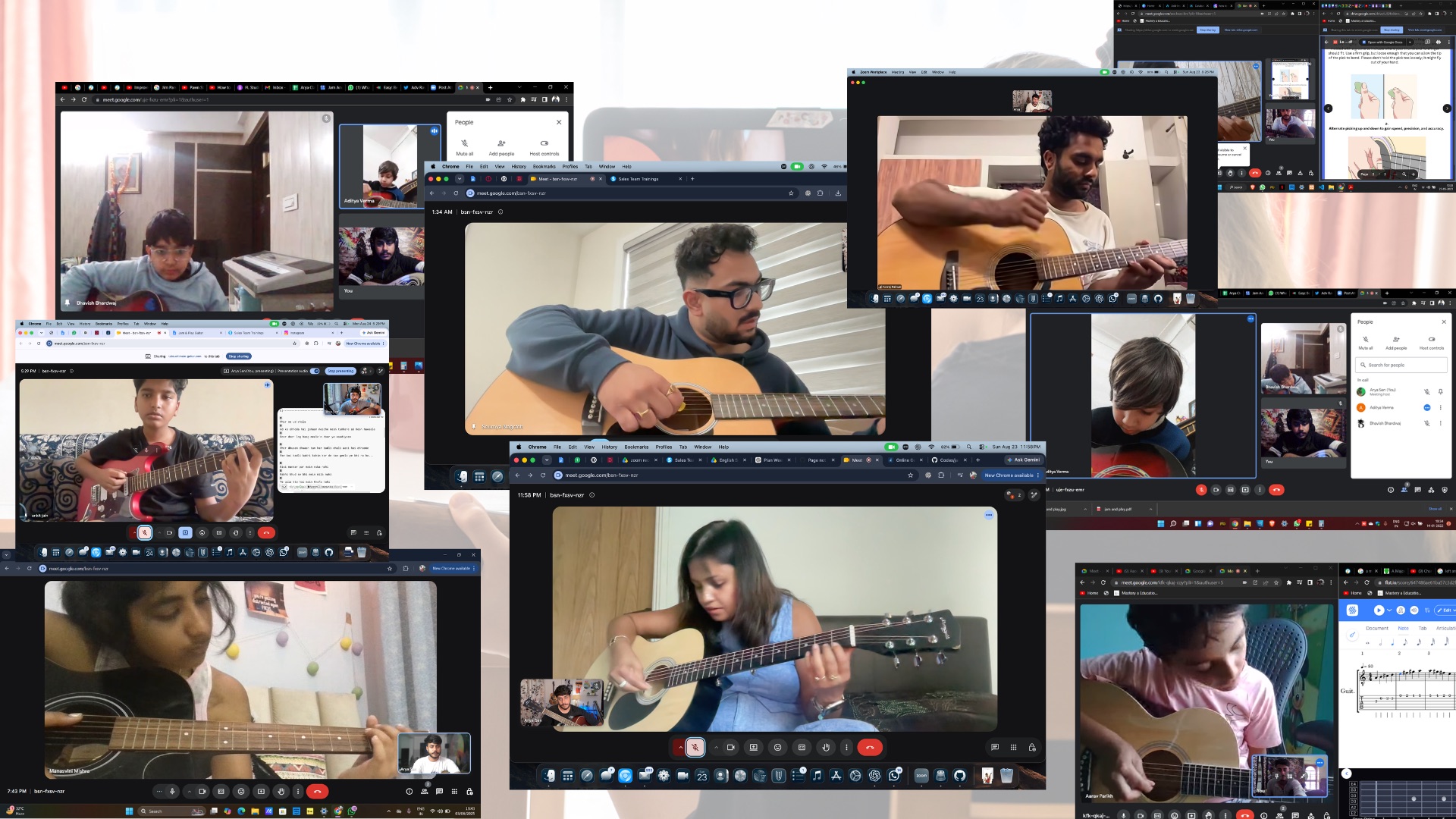
Starting guitar from the United States can give an NRI learner access to teachers and musical approaches beyond the local area. It can also create practical questions: which time zone should the calendar use, what equipment is actually needed, and how can lessons include both Indian and Western music without becoming unfocused?
Online guitar classes for NRI beginners in the USA work best when those details are settled before the course begins. A clear lesson time, a camera angle that shows both hands, an instrument that is comfortable to play and a small weekly practice plan matter more than collecting apps or accessories.
Who is this guide for?
This guide is for an adult, teenager or parent in the USA comparing live online guitar lessons with a teacher outside the country. It is especially useful when the learner wants personal feedback, has Indian and Western songs in mind, or needs a class that can fit around school, work and family routines.
A complete beginner does not need to know chords, read notation or understand music theory before the first class. The teacher should be able to begin with posture, tuning, clear notes, simple rhythm and an appropriate first musical goal.
Explore Jam And Play's USA online music lessons
Start with the learner's goal, not the country
Location affects scheduling and technology, but it should not determine the entire curriculum. Two NRI beginners in the same American city may want completely different things. One may want to accompany Bollywood songs, another may prefer rock riffs, and another may be preparing to play casually with friends.
- Name two or three songs that made you want to learn.
- Decide whether singing while playing is part of the goal.
- Share whether you prefer acoustic or electric guitar.
- Explain any previous experience, even if it was brief.
- Mention school, work or travel periods that may affect practice.
These details help the teacher choose a suitable starting point. They also prevent the class from becoming a generic sequence that feels unrelated to the learner's musical life.
Choose a lesson time using the exact time zone
The USA covers several time zones, so a city name or the word USA is not enough for scheduling. Share the learner's city and current time zone, and make sure every recurring calendar event displays the correct local time.
Daylight-saving changes can alter the time difference between the USA and countries that do not change clocks on the same dates. Before each seasonal change, check the next lesson in both calendars instead of assuming the previous offset still applies.
- Write the lesson time in the learner's local time zone.
- Use a calendar invitation that updates across time zones.
- Check whether the teacher is referring to the same date as the learner.
- Leave a buffer after school, work or another online meeting.
- Confirm changed clock times before the first affected lesson.
The best slot is not merely one that is technically available. It should also match the learner's energy. A child may struggle late in the evening, while an adult may need a short break after work before concentrating on the guitar.
Read the broader checklist for NRI guitar students
Decide between acoustic and electric guitar
Either instrument can be a valid starting point. Choose according to the music the learner wants to play, the physical comfort of the instrument, the available practice environment and the additional equipment the setup may require.
An acoustic guitar is self-contained and easy to begin with, but its body size and string feel still need to suit the player. An electric guitar may feel comfortable and allow headphone-based practice through suitable equipment, but the learner also needs a way to produce and share the sound during class.
If possible, ask the teacher for guidance before buying. A visually appealing guitar is not automatically comfortable, and an instrument that is difficult to tune or play can make beginner exercises unnecessarily frustrating.
Compare acoustic and electric guitars for beginners
Build a simple online lesson setup
A live class needs a stable video call, usable audio and a clear view of the guitar. Expensive production equipment is not a requirement for a beginner lesson. Start with the device and connection already available, then improve only the part that prevents useful feedback.
- Place the phone, tablet or laptop on a stable surface.
- Frame the picking hand, fretting hand and upper-body posture.
- Use front or side lighting so the fingers are visible.
- Keep the device charged or connected safely to power.
- Reduce background noise where reasonably possible.
- Keep a tuner, picks and lesson notes within reach.
Test the camera from the teacher's point of view. A screen that looks fine to the learner may crop the end of the neck or hide the picking hand. During the first class, be ready to adjust the angle when the teacher needs a closer view.
Check what equipment online guitar classes need
Make sure the teacher can hear the guitar
Video-call software is often designed around speech. It may soften sustained notes, reduce quiet acoustic playing or treat amplified guitar as background noise. The teacher cannot correct tone and rhythm accurately if the instrument disappears from the call.
Play a short passage during the setup check and ask whether both speech and guitar are clear. Depending on the device and call platform, moving the microphone, changing a noise-control setting or adjusting amplifier volume may help. Change one thing at a time and test again.
Use music from both parts of the learner's life
Many NRI learners grow up hearing more than one musical tradition. A useful guitar plan can include Bollywood songs, regional-language music, Western pop, rock, film themes or other styles that genuinely interest the learner.
Song choice still needs to match the current skill. A favourite recording may contain fast changes, layered instruments or advanced techniques. The teacher can simplify a section, teach its underlying chord progression or choose a related song that builds the missing skill first.
- Keep one motivating song as a medium-term goal.
- Use easier material to build the technique required for it.
- Learn rhythm and timing instead of memorising shapes alone.
- Ask which part of the recording the lesson arrangement follows.
- Review how the exercise connects to the chosen music.
See how NRI learners can study Bollywood guitar songs online
What the first few lessons should establish
The exact order will vary, but the early lessons should make independent practice safer and clearer. The learner should understand how to hold the instrument, tune with guidance, produce a clear note and follow a simple rhythm before being given too much material.
- Comfortable sitting or standing position.
- Names or numbers used to identify strings and frets.
- A basic tuning process.
- Simple finger and picking coordination.
- One or two manageable chord shapes or a short melody.
- A steady pulse and a way to count it.
- A written or recorded practice assignment.
A good first stage is not measured by the number of chords listed in a notebook. It is measured by whether the learner knows what to practise, can recognise a problem and has a way to ask for help.
Create a weekly practice plan around American routines
School days, extracurricular activities, office hours and commuting patterns vary from family to family. Choose practice windows based on the household's real week rather than a fixed idea of when musicians should practise.
A repeatable plan may combine a few short sessions with one longer review. Give each session one purpose: chord clarity, rhythm, a transition or a short song section. This reduces the temptation to play from the beginning every time while avoiding the difficult bar.
- Begin by tuning and reviewing the teacher's main correction.
- Work slowly on one small technical problem.
- Apply it to the assigned song or exercise.
- Record a short attempt when comparison would be useful.
- Write one question for the next live lesson.
When the week becomes busy, reduce the assignment instead of abandoning it. A smaller, clearly defined task keeps the next lesson connected to the previous one.
Learn how often beginners may take online guitar lessons
Understand the parent's role for younger learners
A parent can help by preparing the device, protecting lesson time and reminding the child of the agreed practice routine. The parent does not need to become the guitar teacher or correct every mistake.
During the first classes, stay close enough to help with technology if requested. As the learner becomes comfortable, allow the teacher and student to communicate directly while remaining available for scheduling or practice questions.
Use the demo lesson as a real compatibility check
A demo should reveal more than whether the video call connects. Bring the instrument, play something if you have previous experience, and explain the musical goal. Notice whether the teacher listens, gives a clear correction and describes a practical next step.
- Can the teacher see and hear the instrument clearly?
- Does the explanation make sense to the learner?
- Is the suggested material suitable for the current level?
- Can the schedule be stated clearly in the learner's time zone?
- Will practice instructions be easy to follow between classes?
- Does the lesson connect technique with music the learner values?
Questions to ask before enrolling
- Is the class live, recorded or a combination?
- Is the lesson individual or shared with other learners?
- How are assignments and corrections communicated?
- What device position should be prepared before class?
- How should an electric guitar be connected or amplified?
- How are time-zone changes handled in the calendar?
- Can the learning plan include both Indian and Western songs?
The answers should be specific enough to picture an ordinary week of learning. If the process remains vague, use the demo to test the details before making a longer commitment.
Common mistakes to avoid
- Choosing a recurring time before confirming the exact time zone.
- Buying accessories before checking what the lesson actually needs.
- Positioning the camera so only one hand is visible.
- Selecting songs only by popularity rather than difficulty.
- Practising complete songs while ignoring the assigned correction.
- Collecting multiple apps and videos without following one plan.
- Waiting until the next lesson to mention an audio problem.
Begin with a clear first step
Online learning can connect an NRI beginner in the USA with live guidance while keeping practice inside a familiar home routine. The strongest start is simple: define the musical goal, confirm the local lesson time, prepare a visible camera angle and leave the first class with one manageable assignment.
Jam And Play offers live online guitar lessons for learners in different countries. Share your city, time zone, age or working routine, current level and preferred music so the first conversation can focus on a suitable lesson setup and learning direction.
Want a clearer first step?
Meet a mentor, talk about what you want to play and get a learning plan built around your schedule.