Online electric guitar classes for NRI beginners: a practical guide
Choose online electric guitar classes for NRI beginners with a simple home setup, live feedback, time-zone planning and a structured first-month roadmap.
August 20265 min read
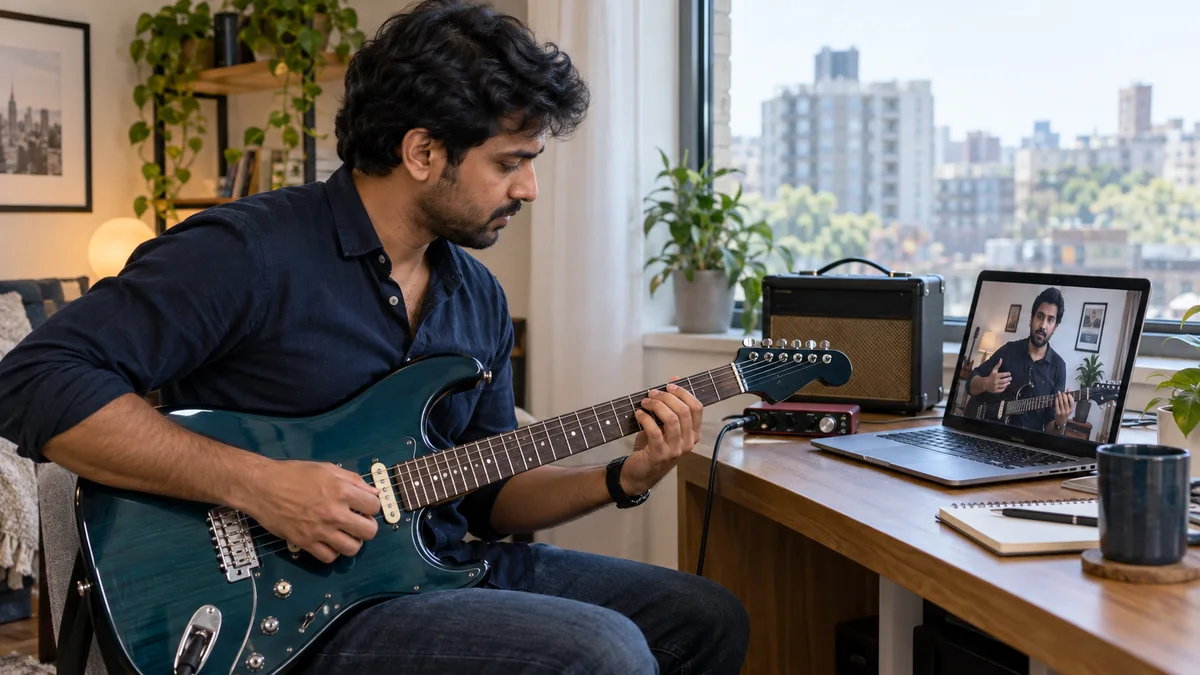
Electric guitar can be a practical instrument for learning at home. You can control the listening level more easily than many beginners expect, explore clean and driven sounds and connect technical exercises directly to riffs, chords and songs.
For NRI learners, online lessons also make it possible to study with an Indian teacher while living abroad. The important part is choosing a class that can work with your time zone, hear your guitar clearly and teach more than effects or isolated song clips.
Who should begin on electric guitar?
You do not have to learn acoustic guitar first. Electric guitar can be a suitable starting instrument when its feel and sound match the music that motivates you.
- You enjoy rock, blues, metal, pop, film music or lead-guitar parts.
- Riffs and solos interest you more than acoustic accompaniment.
- You want to explore clean sounds, distortion and effects gradually.
- Your home needs controllable practice volume.
- The guitar feels comfortable for your hands and body.
- A teacher can help you build technique before adding complicated gear.
The best first instrument is one that supports the music you want to make and can be played comfortably. A difficult setup or unsuitable guitar can make normal beginner work feel much harder.
Compare acoustic and electric guitar for beginners
Start with a simple electric-guitar setup
You do not need a large pedalboard or professional recording system for the first lesson. Begin with a playable guitar and one reliable way to hear it.
- An electric guitar in playable condition.
- A suitable instrument cable when the listening device requires one.
- A small amplifier, practice amp, modeller or another appropriate listening setup.
- A tuner or tuning app.
- A stable phone, tablet or computer for the video call.
- A pick if your lesson uses one.
- A comfortable chair or strap and enough space to move both hands.
If you already own several effects, use a simple clean sound during the initial setup check. A clear tone makes it easier for the teacher to hear muted notes, uneven picking and timing.
Explore Jam And Play's electric guitar classes
Make sure the teacher can hear you and the guitar
The lesson needs a balance between speech and instrument sound. If the amplifier is too far from the device, the guitar may disappear. If it points directly into the microphone at high volume, speech and note detail may become unclear.
- Record a short test clip at your normal lesson volume.
- Speak and play in the same recording.
- Move the amplifier or device until both are understandable.
- Turn off unnecessary effects during the test.
- Reduce fan, television and conversation noise.
- Keep the amplifier at an appropriate household volume.
An audio interface can improve some setups, but it is not automatically required for a beginner. Test the device and amplifier you already have before buying more equipment.
Use the complete online guitar class equipment checklist
Set the camera for technique feedback
Place the camera far enough away to show the guitar neck, fretting hand, picking hand and upper-body posture. A teacher cannot correct picking depth or finger placement if the instrument is outside the frame.
- Use a stable stand instead of holding the phone.
- Keep the fretting fingers visible from the front or a slight angle.
- Show the picking hand and the strings near the bridge and pickups.
- Use enough light to see finger and pick movement.
- Avoid a bright window directly behind you.
- Move closer temporarily when the teacher needs a detailed hand view.
Headphone practice and online lessons
Headphones can be useful when normal speaker volume would disturb other people. The teacher still needs a way to hear the guitar. A setup that sends the guitar only to your headphones may leave the teacher hearing only the unplugged strings.
Before the first class, confirm how your chosen amp, modeller or computer routes sound into the call. If that feels complicated, use a simple speaker setup at a suitable volume for the demo and ask the teacher what is actually necessary.
Plan lesson time across countries
A class can be technically available but still be difficult to maintain. Consider your local work or school routine, the teacher's time zone and seasonal clock changes where applicable.
- Confirm the time in both locations before the first lesson.
- Check whether daylight-saving changes may shift the difference.
- Leave a buffer after work, school or commuting.
- Choose a time when you can play at an appropriate volume.
- Avoid a slot that regularly reduces sleep.
- Understand the rescheduling process before joining.
Read the broader guide to online guitar classes for NRI students
What the first month should teach
A useful beginner roadmap develops control before speed and connects exercises to music. It should not spend every lesson changing presets or beginning a completely unrelated song.
- Comfortable sitting or standing position.
- Basic tuning and instrument controls.
- Pick grip or finger approach appropriate to the material.
- Clear single notes and simple finger exercises.
- Muting unwanted strings.
- A small set of power chords, open chords or both.
- Steady counting and simple rhythm.
- One manageable riff, melody or song section.
The exact order should follow the learner's level, hands and goals. A student interested in rhythm guitar may begin differently from someone motivated by lead playing, but both need timing and controlled movement.
Learn clean technique before hiding it with effects
Distortion can make electric guitar exciting, but it also amplifies unwanted string noise. Practising with a cleaner sound can reveal whether each note is clear and whether unused strings are being muted.
Effects should serve the music rather than replace technique. Add gain, delay, modulation or other processing after you can hear what the hands are doing.
Learn how online lessons can correct guitar technique
Understand latency during online music lessons
Normal video calls can introduce delay between two locations. That makes perfectly synchronised live jamming difficult. A useful teacher does not depend on both people playing the same part at exactly the same time.
- The teacher demonstrates while the student listens.
- The student plays while the teacher observes.
- A metronome or backing track runs from the student's side.
- Short sections are recorded and reviewed.
- The teacher counts the student in, then listens without playing over them.
This turn-based approach still allows detailed work on rhythm, technique and songs without pretending the internet delay does not exist.
Choose music that fits your identity and level
NRI beginners may want to learn English-language rock and pop, Bollywood songs, regional Indian music, worship music or styles connected to school and local friends. Share that mix during the demo.
A difficult song can be reduced to a simple riff, power-chord part, melody or rhythm exercise. The teacher should preserve something recognisable while matching the arrangement to the technique you currently have.
See how NRI students can learn Bollywood songs online
Use a focused electric-guitar practice routine
Short sessions on several days are easier to maintain than one long session immediately before class. Keep the amp or listening setup ready enough that connecting it does not consume the entire practice window.
- Tune and choose a simple sound.
- Warm up slowly with the current technical focus.
- Practise one difficult movement in isolation.
- Apply it to the assigned riff, chord or song section.
- Check timing with a steady pulse when appropriate.
- Record one controlled attempt and note a question.
Do not increase speed until the movement can be repeated with clear notes and manageable tension. Stop forcing the hand if you feel sharp pain, numbness or unusual discomfort.
How often should beginners take lessons?
One lesson each week is a practical starting point for many beginners because it creates regular feedback and leaves time for repetition. Some learners benefit from closer contact, while others need a slower schedule because of work, school or family demands.
The right frequency depends on how often you can practise and how independently you can recognise correct technique.
Read the full guide to online guitar lesson frequency
Questions to ask during a demo
- Is my electric guitar comfortable and playable?
- Can the teacher hear my speech and guitar clearly?
- Does the camera show both hands?
- What will the first four weeks focus on?
- How will rhythm and unwanted string noise be corrected online?
- Can my preferred music be simplified to my current level?
- How will the schedule work in my time zone?
- What should I practise before the next class?
Signs the class is working
- You understand why each exercise is included.
- Your notes and rhythm become more consistent.
- The teacher corrects movement rather than only naming songs.
- Effects are introduced with a musical purpose.
- The practice task fits the time you actually have.
- You know what to listen for between lessons.
Start with the sound that makes you want to practise
Online electric guitar classes for NRI beginners work best when the instrument is playable, the signal is clear, the teacher can see both hands and the schedule fits the student's local routine. A simple setup and structured roadmap provide room to explore sound without losing the fundamentals.
Jam And Play offers live online guitar lessons with personalised guidance and flexible scheduling. Book a free demo to test your setup, discuss your musical interests and plan a beginner roadmap.
Want a clearer first step?
Meet a mentor, talk about what you want to play and get a learning plan built around your schedule.