Online guitar classes for NRI teenagers: what families should check
Choose online guitar classes for NRI teenagers with the right schedule, teaching style, music choices, practice plan and balance of parent support.
August 20265 min read
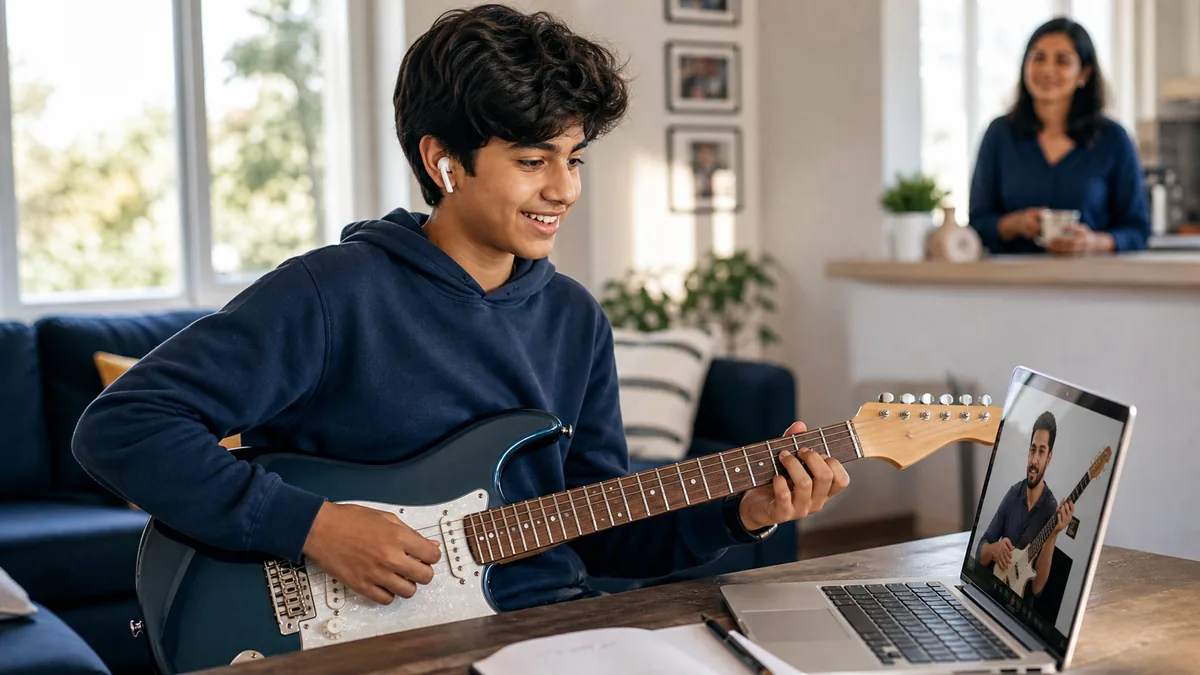
Teenagers often begin guitar with a strong musical identity. They may want to play a current song, join a school band, accompany their singing or understand the guitarists they follow. A class that ignores those interests can feel disconnected, even when the technical material is correct.
For NRI families, the choice also involves time zones, school commitments and whether the teacher can connect different musical influences. The best online guitar classes for NRI teenagers combine a clear foundation with enough independence for the student to take ownership of practice.
Start with the teenager's reason for learning
Parents and teachers may have useful goals, but the learner needs a reason to pick up the guitar between lessons. Ask the teenager what they want to do with the instrument before choosing a course.
- Play and sing favourite songs.
- Learn riffs, solos or fingerstyle arrangements.
- Join a school, community or worship band.
- Write original music.
- Prepare for a graded exam or performance.
- Build a creative hobby away from schoolwork.
- Explore Bollywood, regional Indian music and music popular where they live.
The first goal does not need to determine the entire future. It gives the teacher a useful starting point for choosing songs, examples and practice tasks.
Acoustic or electric guitar for a teenager?
Acoustic guitar offers a direct setup for chords, singing and many song styles. Electric guitar may suit a learner drawn to rock, blues, metal, lead playing or effects. One is not a compulsory first step before the other.
Choose according to musical interest, comfort, available practice space and the equipment the family can manage. The instrument should be playable and appropriate for the student's size. A difficult setup can make ordinary beginner work feel like a lack of ability.
Compare acoustic and electric guitar for beginners
Explore Jam And Play's electric guitar classes
Choose a schedule around school energy, not only availability
A time slot can be open and still be a poor lesson time. A teenager joining immediately after a long school day, sports practice or late homework may struggle to concentrate. A very early weekend slot can also fail if it conflicts with the family's routine.
- Convert the class time for the student and teacher.
- Check how daylight-saving changes may affect the difference.
- Leave a short buffer after school or activities.
- Avoid using the time normally protected for sleep.
- Check examination periods and recurring school events.
- Understand the rescheduling policy before joining.
Consistency is useful, but a sustainable slot is better than a perfect-looking timetable that causes repeated cancellations.
The class should be live and interactive
Recorded videos can demonstrate a chord or song, but they cannot hear one student's buzzing note, uneven rhythm or question. Live online teaching allows the teacher to watch, listen and adjust the task.
During a demo, notice how much the teenager actually plays. The teacher should ask questions, hear an attempt and give feedback the student can test. A lesson where the teacher performs for most of the time may be interesting but provides limited information about the learner.
See how Jam And Play's live online guitar classes work
Set up the camera for real feedback
Place the device on a stable stand where both hands, the guitar neck and upper-body posture are visible. The teenager should not need a parent to hold the phone throughout the lesson.
- Use enough light to see the fretting fingers.
- Keep the picking or strumming hand inside the frame.
- Test the microphone with the actual guitar.
- Reduce fan, television and conversation noise.
- Keep the device connected to power for longer sessions when needed.
- Prepare the guitar, tuner and lesson notes before joining.
Use the complete online guitar class equipment checklist
Look for structure without making music feel like another subject
Teenagers need a learning sequence, not a different random song every week. At the same time, a course made only of abstract exercises may lose connection with the music that brought them to guitar.
A balanced lesson can connect technique to a real result. Chord changes lead into accompaniment, scales support a riff or solo, rhythm exercises improve a current song and basic theory explains patterns already appearing on the fretboard.
- Technique and posture appropriate to the instrument.
- Rhythm and counting, not only chord diagrams.
- Songs chosen at a manageable difficulty.
- Basic fretboard or theory ideas connected to playing.
- Short performance or recording goals.
- A clear task to practise before the next class.
Give teenagers some control over song choices
A teacher does not need to teach every request exactly as recorded. A difficult arrangement can be simplified into a chord progression, riff, melody or rhythm pattern that matches the student's current technique.
For NRI teenagers, the song list may naturally cross cultures. A learner might enjoy Bollywood music at home, English-language music with friends and another style through school. That mix can become part of the curriculum instead of a choice between two identities.
Read how NRI students can learn Bollywood songs online
What should parents manage?
Parents should make the lesson possible without taking over it. Teenagers need room to answer the teacher, make mistakes and build responsibility for their own practice.
- Help confirm the schedule and payment arrangements.
- Provide a suitable instrument and stable lesson space.
- Support agreed practice time without monitoring every note.
- Ask whether the student understands the weekly task.
- Communicate safety, scheduling or motivation concerns privately when needed.
- Allow the teacher and teenager to discuss musical goals directly.
A parent does not need to become the second guitar teacher. Constant corrections from outside the lesson can create mixed instructions and turn practice into a conflict.
What should the teenager manage?
- Join with the guitar tuned or ask for tuning help at the start.
- Keep lesson notes and practice instructions in one place.
- Complete several short practice sessions rather than one rushed session.
- Record questions or difficult sections for the teacher.
- Say when a task feels unclear, too easy or too difficult.
- Respect the agreed lesson time and communication process.
Build a practice plan around homework and activities
An ambitious daily plan often disappears during exams or busy school weeks. Use a minimum practice option and a fuller option so the routine can adapt without losing direction.
The ten-minute minimum
- Tune and check posture.
- Repeat one technical movement slowly.
- Practise one chord transition or short riff.
- Play the smallest section of the current song.
- Note one question for the next lesson.
The fuller session
- Warm up with the current technical focus.
- Practise the difficult section in isolation.
- Connect it to the bars before and after.
- Use a steady pulse or backing track when appropriate.
- Make one complete recording without restarting.
The teacher should help choose a realistic length based on level, school load and attention. More minutes do not help when the practice repeats an unclear movement.
Use recordings as a learning tool
A short recording can show progress and reveal what changes when the teacher is not present. It can also support performance confidence without requiring the teenager to publish anything online.
- Record one short section rather than an entire long song.
- Use the same camera angle when comparing attempts.
- Include the tempo if timing is the focus.
- Listen once for rhythm and once for note clarity.
- Choose one improvement for the next recording.
Keep recordings private unless the learner and family intentionally choose to share them. Practice does not need to become social media content.
One-to-one or group lessons?
One-to-one lessons can follow one teenager's pace, songs and technical needs. Group classes can add social energy and shared playing when the levels and goals fit.
Ask how much individual playing time and feedback the student receives. The right label matters less than whether the teenager is heard, corrected and given a useful next task.
Compare one-to-one and group online guitar classes
How families should assess progress
Do not judge every month only by the number of complete songs. Early progress may appear as cleaner notes, steadier rhythm, better tuning habits, smoother chord changes and the ability to practise without constant reminders.
- The student can explain the current goal.
- Practice tasks connect to the lesson.
- Recordings show one specific improvement.
- The teenager asks more precise musical questions.
- The teacher can describe what improved and what comes next.
- The student still has room to play music for enjoyment.
Warning signs in an online class
- The teenager rarely plays during the lesson.
- Every week introduces unrelated material.
- Feedback is vague and cannot be tested.
- The camera angle never allows technique correction.
- Songs are consistently far above or below the student's level.
- The schedule repeatedly conflicts with school or sleep.
- Parents and the learner do not understand the practice plan.
Questions to ask during the demo
- What will the first month focus on?
- How will the teacher include the teenager's musical interests?
- Can both hands be seen clearly on camera?
- How are rhythm and technique corrected online?
- What practice plan will be given after class?
- How will the schedule work across our time zone?
- How are parents updated without removing the student's independence?
Read the broader guide to online guitar classes for NRI students
Choose a class the teenager can own
Online guitar classes for NRI teenagers work best when the learner has a meaningful goal, live feedback, a practical schedule and responsibility for the weekly plan. Parents provide the environment; the teenager develops the habit.
Jam And Play offers live online guitar lessons with personalised guidance and flexible scheduling. Book a free demo to discuss the teenager's music, current level, school routine and time zone before choosing the next step.
Want a clearer first step?
Meet a mentor, talk about what you want to play and get a learning plan built around your schedule.