Online guitar classes for NRI kids: a parent's checklist
A practical checklist for choosing online guitar classes for NRI kids, covering readiness, instrument fit, time zones, live feedback and home practice.
August 20265 min read
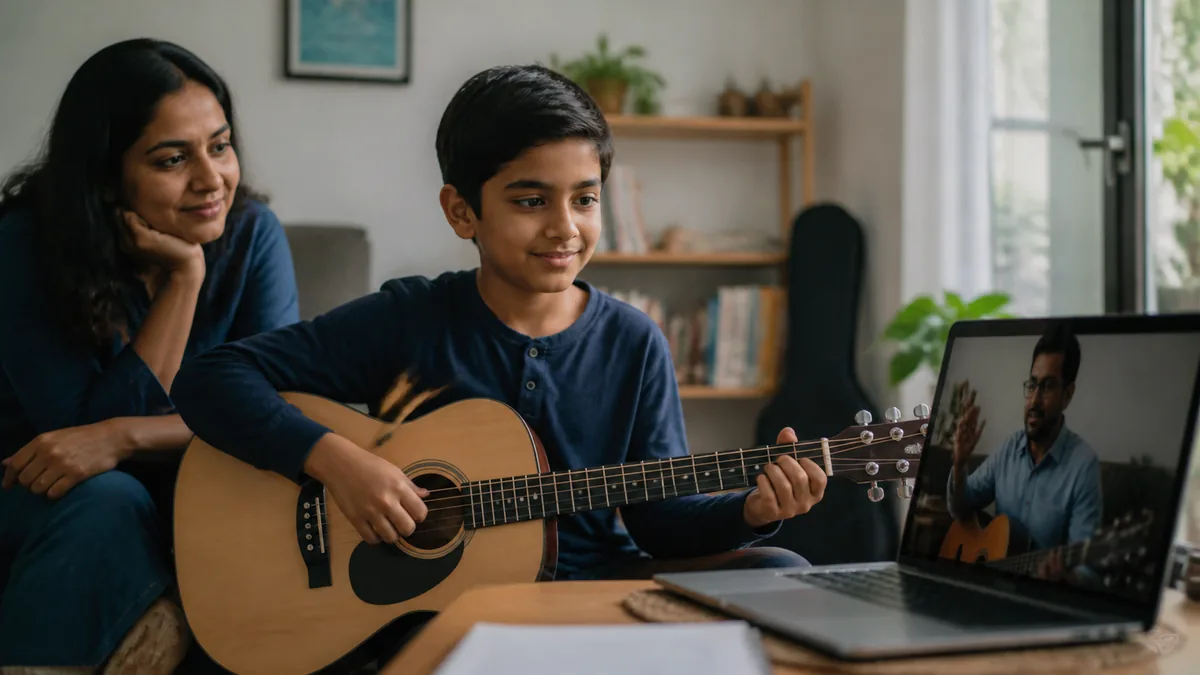
Choosing an online guitar class for a child is different from choosing one for yourself. Parents need to consider more than the teacher's available time. The instrument must fit, the lesson needs to hold the child's attention and the practice plan has to work around school and family life.
For NRI families, time zones and musical goals add another layer. A child may want to learn English pop, Bollywood songs, graded pieces or a mix of everything. The right class should build a solid foundation while keeping that personal connection to music.
Is your child ready to begin guitar?
There is no single perfect age for every child. Readiness depends on attention, hand comfort, interest and the ability to follow a few simple instructions. A motivated child with a suitable instrument may be ready earlier than an older child who does not yet enjoy the idea of practising.
- The child shows genuine interest in guitar or guitar-based music.
- They can focus on one activity for a short lesson segment.
- They can follow simple instructions and describe when something feels uncomfortable.
- They are willing to repeat a small exercise several times.
- The family can support a regular practice routine without turning it into a daily argument.
A demo lesson can help a teacher assess readiness without forcing the family to make a long commitment first.
Read more about the best age to start guitar lessons
Choose a guitar that fits the child
A guitar that feels too large or difficult to press can make a beginner believe they are failing. The child should be able to sit comfortably, reach the first few frets and place the strumming arm without lifting the shoulder.
The right choice may be a smaller acoustic guitar, a nylon-string instrument, an electric guitar with a suitable setup or another beginner-friendly option. The teacher should consider the child's size, musical interests and available equipment before recommending a purchase.
Explore Jam And Play's acoustic guitar classes
Check the time zone and the child's energy
A lesson slot can be technically available and still be a poor fit. A child joining late after a full school day may struggle to concentrate, while an early weekend class may clash with family routines or activities.
- Convert the lesson time for both the teacher and student.
- Check whether daylight-saving changes may shift the difference.
- Choose a time when the child is normally alert rather than simply free.
- Leave a short buffer after school, meals or sports.
- Ask how rescheduling works when school events or travel interrupt the routine.
Consistency matters, but the most consistent slot is the one the family can realistically protect.
Explore online music lessons for families in the United States
Explore online music lessons for families in the United Kingdom
Explore online music lessons for families in the UAE
Look for live teaching, not only recorded videos
Recorded lessons can be useful for revision, but they cannot see that the child's wrist is tense, that a chord is buzzing or that the rhythm changes speed every few bars. Live feedback helps correct those issues before they become frustrating habits.
During a demo, notice whether the teacher asks the child to play, listens carefully and gives one clear correction at a time. The session should feel interactive rather than like watching another tutorial.
See how Jam And Play's live online guitar classes work
Ask how the lesson is structured for children
Children often respond better when a lesson changes activity before attention fades. A class might combine a warm-up, one technical idea, rhythm practice and a small part of a song. The exact balance should depend on age, level and concentration.
A useful lesson plan builds skills in order. It should not introduce a completely unrelated song every week simply to keep the class entertaining.
- What will the first month focus on?
- How are posture and clean technique corrected online?
- How are songs chosen for the child's level?
- Will rhythm, tabs and basic theory be included?
- How does the teacher adjust when the child progresses faster or needs more time?
Make music choices part of the conversation
A child is more likely to practise when the music feels relevant. NRI students may enjoy songs from their local environment, music their parents play at home or Bollywood songs connected to family and language.
The teacher does not need to teach every request exactly as recorded. A difficult song can be simplified into an age-appropriate chord pattern, melody or rhythm exercise while preserving something the child recognises.
Learn how NRI students can approach Bollywood songs online
Understand the parent's role
Parents do not need to become guitar teachers. Their job is to make practice possible, help the child remember the assignment and communicate when the routine is not working. Correcting every note from outside the lesson can create tension, especially when the parent is also learning.
- Help prepare the device and guitar before class.
- Keep the practice instructions visible and simple.
- Encourage effort without demanding a perfect performance.
- Share scheduling or motivation concerns with the teacher.
- For younger children, stay close enough to help with technology when needed.
Ask for a practice plan the family can maintain
A vague instruction to practise more is difficult for a child to follow. A better plan names two or three small tasks: tune with help, change between two chords slowly and play four bars of a song.
Short sessions repeated during the week are usually easier to manage than one long practice session immediately before class. The teacher can adjust the length according to the child's age, hands and attention.
Set up the camera so the teacher can actually teach
Place the device on a stable stand where the teacher can see both hands, the guitar neck and the child's sitting position. Avoid holding the phone during the lesson. Use a quiet, well-lit space and tune the guitar before class when possible.
The built-in camera and microphone on a phone, tablet or computer are usually enough to begin. Test the setup during the demo before buying extra equipment.
Use this equipment checklist for online guitar classes
How should parents judge progress?
Progress is not only the number of complete songs. Notice whether the child sits more comfortably, makes clearer notes, keeps a steadier beat and remembers what to practise. Confidence to recover after a mistake is also more useful than stopping every time something goes wrong.
Ask the teacher for specific feedback: what improved, what needs attention and what the child should focus on before the next class.
Questions to ask during the demo lesson
- Is the guitar an appropriate size and setup for my child?
- Can the teacher see both hands clearly?
- Does the child respond comfortably to the teaching style?
- Is the lesson active and interactive?
- What should the child practise before the next session?
- How will parents receive progress updates?
- Can the schedule remain practical across our time zone?
Read the full guide to online guitar classes for NRI students
See what families should check for NRI teenagers
Choose a class your child can enjoy and continue
The best online guitar classes for NRI kids combine a suitable instrument, live feedback, an age-appropriate roadmap and music the child cares about. The schedule should work for the family's time zone without placing the lesson at the most tiring part of the day.
Jam And Play offers live online guitar lessons with flexible scheduling and personalised learning plans. Book a free demo, test the setup and let the teacher understand your child's interests before deciding on the next step.
Want a clearer first step?
Meet a mentor, talk about what you want to play and get a learning plan built around your schedule.