Online acoustic guitar classes for NRI beginners: a practical guide
Explore online acoustic guitar classes for NRI beginners, from choosing an instrument and lesson time to practising chords, rhythm and songs at home.
August 20265 min read
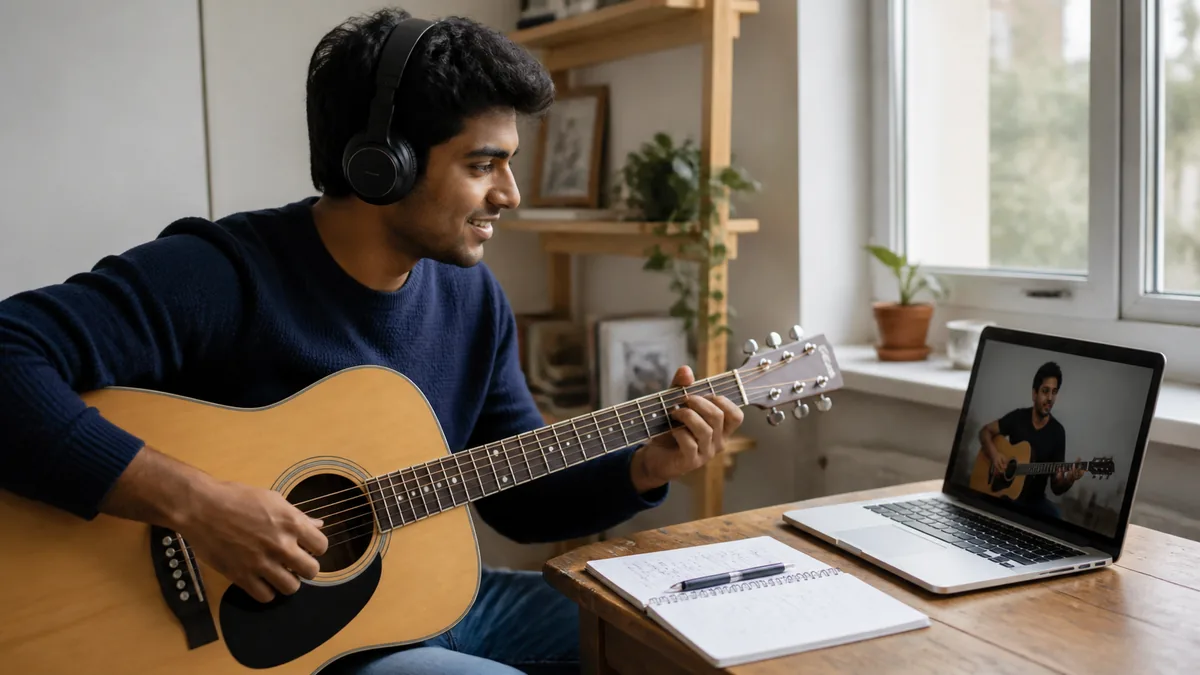
An acoustic guitar is a convenient instrument for learning at home because the basic setup is simple: a playable guitar, a tuner and a place to practise. For NRI beginners, online lessons can also make it easier to learn with an Indian teacher while living abroad.
The useful question is not only whether online acoustic guitar classes work. It is whether the guitar, teacher, schedule and practice plan fit your life. This guide explains what to check before joining online acoustic guitar classes for NRI beginners and how to make the first few weeks productive.
Why beginners often choose acoustic guitar
Acoustic guitar can support chord-based songs, singing, simple melodies, fingerstyle and rhythm practice without an amplifier. You can pick it up for a short session without connecting extra equipment.
That simplicity does not mean the first weeks are effortless. New fingers need time to learn accurate placement, and a poorly adjusted guitar can make clean notes unnecessarily difficult. The right lesson should help you separate normal beginner challenges from problems caused by the instrument.
Explore Jam And Play's acoustic guitar classes
Choose the guitar before choosing accessories
Do not begin by buying a long list of accessories. First make sure the instrument is comfortable, holds its tuning and suits the learner's size. A teacher can assess the guitar during a demo if you already own one.
- The body should feel manageable while sitting.
- The fretting hand should reach the first few frets without twisting the wrist.
- The strings should not feel unusually high above the fretboard.
- The tuning machines should turn smoothly and hold the pitch.
- Each string should sound clearly when played open.
- The guitar should not produce severe buzzing across normal beginner notes.
If the strings are very difficult to press, the answer is not always more finger strength. The guitar may need a setup, different strings or a different size. Ask for guidance before replacing it.
Steel-string or nylon-string acoustic guitar?
Steel-string acoustic guitars are common in pop, rock, folk and Bollywood accompaniment. Nylon-string guitars have a different sound, wider neck and softer-feeling strings that some beginners prefer. Neither option is automatically correct for every NRI learner.
Choose according to the music you want to play, the comfort of the neck and the teacher's plan. A child may need a smaller instrument, while an adult may prefer a full-size model that feels comfortable. Avoid choosing only from a product photo or the label 'beginner guitar.'
Compare acoustic and electric guitar for beginners
What you need for the first online lesson
You can usually begin with a phone, tablet or computer that has a functioning camera and microphone. Place it on a stable surface so the teacher can see the guitar neck, both hands and your overall posture.
- An acoustic guitar that is in playable condition.
- A clip-on tuner or tuning app.
- A stable device stand rather than a phone held by hand.
- Enough light for the fretting fingers to be visible.
- A quiet room with a reliable internet connection.
- A notebook or digital place for lesson instructions.
- A pick if the lesson plan uses one.
Headphones can make speech clearer, but the teacher still needs to hear the guitar. Test the audio before class and avoid placing the microphone where clothing or a fan covers the sound.
Use the complete online guitar class equipment checklist
Check the camera angle from the teacher's view
A camera facing only your face cannot show why a chord is buzzing. The teacher should be able to see fingertip position, thumb placement, picking movement and whether the shoulder or wrist is tense.
Join the call a few minutes early, sit in the normal playing position and look at your own video preview. Move the device farther away if the headstock or strumming hand disappears from the frame.
Choose a lesson time that works across time zones
For NRI learners, an available slot is not always a sustainable slot. Consider your local work or school routine, the teacher's time zone and changes caused by daylight saving where applicable.
- Confirm the lesson time in both locations before the first class.
- Ask whether the same local time will remain available when clocks change.
- Choose a time when you can concentrate, not simply the last free hour.
- Keep a short buffer after work, school or family commitments.
- Understand the rescheduling policy before committing to a plan.
A regular slot helps build a habit, but the best schedule is one you can protect without repeatedly sacrificing sleep or arriving rushed.
Read the full guide to online guitar classes for NRI students
What the first month should build
A useful beginner plan develops control in a sensible order. It should not jump between unrelated songs every class. The exact sequence will vary, but the foundations usually connect posture, tuning, fretting accuracy, rhythm and small pieces of music.
- Comfortable sitting position and guitar support.
- Basic tuning with guidance.
- Accurate single notes or simple finger exercises.
- A small set of open chord shapes.
- Slow changes between two chords.
- Steady counting and a simple strumming motion.
- One manageable melody, riff or song section.
The teacher should adjust the plan when hand size, coordination or musical goals require a different route. A personalised lesson is not a promise to skip fundamentals; it means connecting those fundamentals to the learner.
Practise for clarity before speed
Beginners often hurry because the original song sounds fast. Speed makes it harder to notice muted strings, uneven rhythm and unnecessary tension. Begin slowly enough to repeat the movement with control.
For chord practice, place one chord carefully and play each string separately. Correct only the string that sounds unclear. Then practise moving between two shapes without strumming. Add a slow rhythm after the movement becomes more reliable.
Use short practice sessions between lessons
A long session once a week is difficult to sustain and leaves little time for the hands to remember new movements. Short sessions on several days can make the assignment feel more manageable.
- Tune and check posture.
- Repeat one finger exercise slowly.
- Work on one difficult chord change.
- Play a small song section with steady counting.
- Note one question for the next lesson.
Stop if you feel sharp pain, numbness or unusual wrist discomfort. Mild fingertip tenderness may occur for new players, but forcing the hand is not a useful practice method.
Choose songs that match your level and identity
NRI beginners may want to learn Bollywood music, English-language pop, regional songs, devotional music or a mix connected to both home and the country where they live. Share those interests during the demo.
A teacher can simplify a difficult request into a chord progression, rhythm pattern or short melody. This keeps the music recognisable while matching the technique you currently have.
Learn how NRI students can approach Bollywood songs online
Live feedback matters for acoustic beginners
Recorded tutorials can show where to place a finger, but they cannot hear your specific buzzing string or see that you are squeezing the neck. Live feedback helps identify whether the problem comes from finger position, pressure, timing, tuning or the guitar setup.
During a demo, notice whether the teacher asks you to play, listens without rushing and gives a correction you can test immediately. The class should involve your guitar, not only the teacher demonstrating theirs.
See how Jam And Play's live online guitar classes work
Questions to ask during a demo
- Is my acoustic guitar suitable for my size and current level?
- Can the teacher see both hands clearly on camera?
- What will the first four weeks focus on?
- How will lesson notes and practice tasks be shared?
- Can the teacher include music I enjoy at an appropriate difficulty?
- How will the schedule work in my time zone?
- What should I record or prepare before the next lesson?
Signs the class is working
Progress is not only the number of complete songs. In the early weeks, look for cleaner individual notes, a more relaxed posture, steadier counting and fewer pauses between familiar chord shapes.
- You understand the purpose of each practice task.
- You can hear or feel one small improvement between lessons.
- The teacher corrects technique as well as teaching songs.
- The assignment fits the time you actually have.
- You know what to practise when a note or chord sounds wrong.
Start with a playable guitar and a clear plan
The best online acoustic guitar classes for NRI beginners combine a comfortable instrument, a useful camera angle, live correction and a schedule that works across time zones. A structured plan should still leave room for the songs and musical traditions that make you want to practise.
Jam And Play offers live online guitar lessons with personalised guidance and flexible scheduling. Book a free demo to check your acoustic guitar, test the online setup and discuss a beginner roadmap based on your goals.
Want a clearer first step?
Meet a mentor, talk about what you want to play and get a learning plan built around your schedule.